How to rank higher on Google Maps comes down to improving the three things Google says it uses for local results: relevance, distance and prominence. You cannot change distance, so the practical work is making your profile match what people search for (relevance) and building the reviews, links and reputation that make you well known (prominence). Google also states that you cannot pay for a better organic local ranking.
Most guides give you a long list of tips with no order. This one prioritises: what moves the needle first, what to leave until later, and what to ignore. It is written for small local businesses in the UK and US, and it avoids promises, because nobody outside Google can guarantee a position. For Google's own explanation, see its tips to improve your local ranking.
Table of Contents
How to rank higher on Google Maps: how Google decides
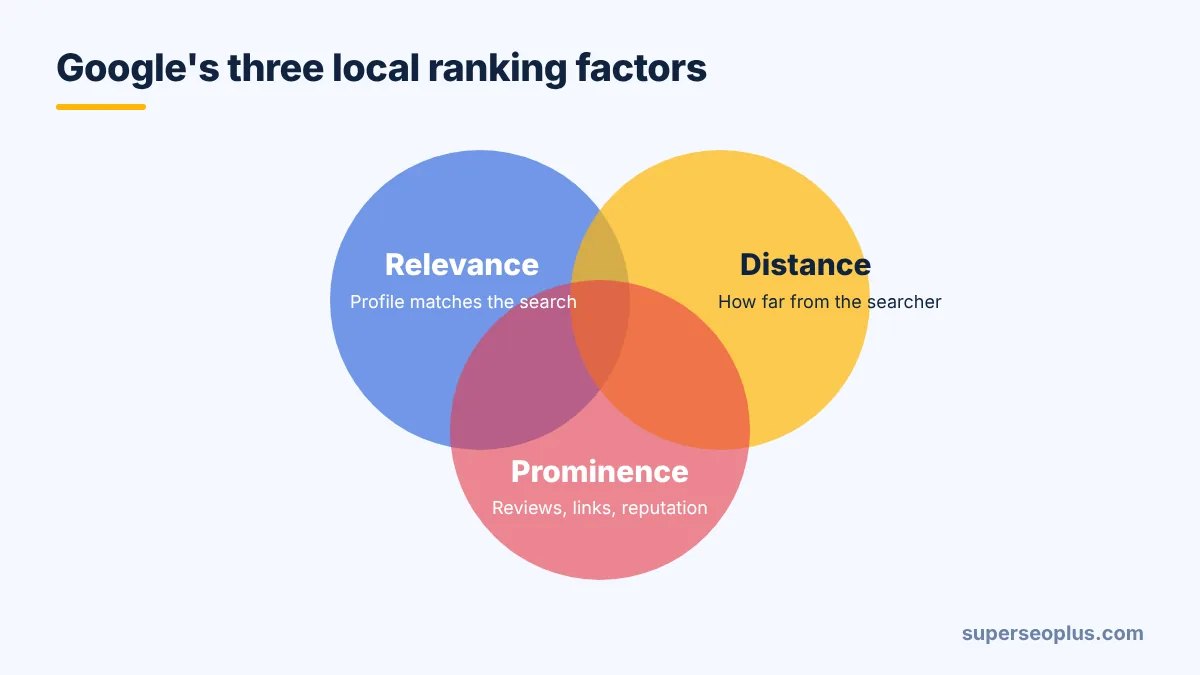
According to Google's help documentation on improving your local ranking:
- Relevance is how well your profile matches the search.
- Distance is how far you are from the searcher, or from the location they specify.
- Prominence is how well known you are, which Google links to things like reviews and links from other websites.
These interact. A closer business with a weaker profile can beat a stronger one further away. That is why rankings vary from street to street. If you are new to this, read what local SEO is first.
First, check that you are visible at all
Before optimising, make sure nothing is broken. An unverified, suspended or ineligible profile cannot rank properly. If your business does not appear when you search for it, use our guide on why your business may not be showing on Google Maps.
Priority 1: Relevance (fix this first, it is cheap)
- Primary category. The most specific accurate category you can choose is the strongest relevance signal you control.
- Services and products. List what you really offer, using the words customers use.
- Description. Write naturally and honestly. Do not stuff keywords.
- Business name. Use your real-world name. Adding keywords or locations breaches guidelines and risks suspension.
- Website content. Service pages that match your categories reinforce relevance.
Our Business Profile optimisation checklist goes through every field.
Priority 2: Prominence
Reviews
Review quantity, recency and rating all feed prominence, and they influence whether people click. Ask every happy customer, make it easy, reply to all reviews, and never buy or incentivise them. See how to get Google reviews.
Links and mentions
Google mentions links from other websites as part of prominence. Relevant, earned mentions from local organisations, suppliers, press and associations are the healthiest kind. Be cautious about low-quality link schemes, which can backfire. Our article on buying backlinks explains the risks.
Need help with off-page SEO?
If you want support earning relevant links alongside your local work, take a look at our off-page SEO and backlinks service on Fiverr. It is an optional extra for businesses that would rather not do outreach themselves.
Accurate listings elsewhere
Consistent name, address and phone details across directories remove conflicting signals. This is industry practice rather than a documented Google ranking rule, and it works best as a foundation. See NAP consistency explained.
Priority 3: Distance (what you can and cannot control)
You cannot move your business to rank better, and you should never fake an address. What you can do:
- Set a realistic service area if you travel to customers. See service-area businesses on Google Maps.
- Understand that you may rank well near your location and poorly further away. Test from several places.
- Consider whether a genuine second location, with a real staffed premises, makes sense. Do not create fake ones.
Priority 4: Engagement and freshness
- Photos: add real, current photos regularly.
- Posts and updates: useful for customers, though their direct ranking effect is unproven.
- Questions and messages: answer them promptly.
- Accurate hours: including holidays.
Where citations fit in
Citations are mentions of your business details on other sites. They are one input among many, not a shortcut. Accurate listings on relevant, reputable sites help your business look established and reduce errors. They will not rescue a poor profile, a thin website or a lack of reviews. See which sites are worth your time in our list of local citation sites for UK and US businesses.
Want Help Keeping Your Listings Accurate?
Accurate listings are one supporting piece of local visibility. If you would like help with that part, explore our Google Maps citations service on Fiverr. It cannot guarantee a ranking, but it can remove errors that hold a profile back.
How to track whether it is working
- Profile performance data in your Business Profile account: calls, direction requests and website clicks.
- Rankings checked from several locations, noting that personalised results vary.
- Review count, rating and response rate each month.
- Enquiries and booked jobs, which matter more than any ranking.
What to ignore
- Promises of "guaranteed number one on Google Maps".
- Fake reviews, fake addresses and fake locations.
- Ranking-factor lists claiming exact percentages. Google does not publish them.
- Posting daily just to "signal activity".
How long does it take?
Fixing errors can show effects within weeks. Competitive markets take months. See how long SEO takes to work for a realistic timeline.
How to rank higher on Google Maps: the short version
How to rank higher on Google Maps starts with being visible, then improving relevance and prominence. If you remember only one thing about how to rank higher on Google Maps, it is to fix errors first and build reviews second. Anyone promising a guaranteed answer to how to rank higher on Google Maps is overselling, because Google decides. Use this list as your working answer to how to rank higher on Google Maps, and revisit it every quarter.
Frequently asked questions
Can I pay to rank higher on Google Maps?
Google says there is no way to request or pay for a better organic local ranking. Paid ads are a separate product.
What is the most important ranking factor?
Google names relevance, distance and prominence. Which matters most depends on the search and the competition.
Do reviews help rank?
Google lists review count and rating as part of prominence, and they affect customer choice either way.
Do I need a website?
Not strictly, but it helps. See local SEO without a website.
If you would like an honest view of where your business stands, request a free SEO analysis.
SuperSEOPlus Editorial is the editorial byline for articles published on SuperSEOPlus. It is a publication byline, not an individual author. The guides cover SEO, local SEO, link building, content marketing, WordPress and digital marketing, and aim to explain how these topics work in practical terms. Where an article recommends third-party tools or products, any affiliate relationship is disclosed in the article. We do not guarantee rankings, traffic or income.
About us and this blog
We are a digital marketing company with a focus on helping our customers achieve great results across several key areas.
Request a free quote
We offer professional SEO services that help websites increase their organic search score drastically in order to compete for the highest rankings even when it comes to highly competitive keywords.
More from our blog
See all posts


Recent Posts
- WordPress Redirect Chains: Build a Safe URL Repair Map November 9, 2026
- Duplicate Title Tags in WordPress: Identify Which Problem You Have November 7, 2026
- Sitemap Couldn’t Fetch in WordPress: Find the Failing Request November 5, 2026