Buy Backlinks: 10 Things to Know Before Paying for Links
- September 21, 2026
- Link Building
Buying backlinks can look simple from the outside: choose a package, pay for the links, and wait for your SEO performance to improve.
In reality, there is much more to consider.
If you search for buy backlinks, you will find everything from inexpensive bulk packages to individual placements on established websites. The prices, quality, relevance, link attributes and methods used can vary enormously.
That is why the most important question is not simply, “Where can I buy backlinks?”
A better question is: “What exactly am I paying for, and does this link make sense for my website?”
This guide explains what you should examine before paying for links, including relevance, website quality, anchor text, link attributes, placement, risks and common warning signs.
What Does “Buy Backlinks” Actually Mean?
When people talk about buying backlinks, they can be describing several very different arrangements.
For example, payment might be associated with:
- sponsored content;
- advertising placements;
- content creation and outreach;
- publisher fees;
- directory or business listings;
- guest content opportunities;
- digital PR campaigns;
- or backlink packages containing multiple placements.
These arrangements should not automatically be treated as identical.
The important distinction is why the link exists and how it is handled.
A legitimate advertising or sponsorship relationship is different from paying for links specifically so they pass ranking signals and manipulate search results.
Before purchasing any service, understand exactly what is being sold, where links may appear and how those links will be treated.
Review my backlink service on Fiverr, including the current package options and deliverables.
10 Things to Know Before You Buy Backlinks
1. Understand Google's Policy on Paid Links
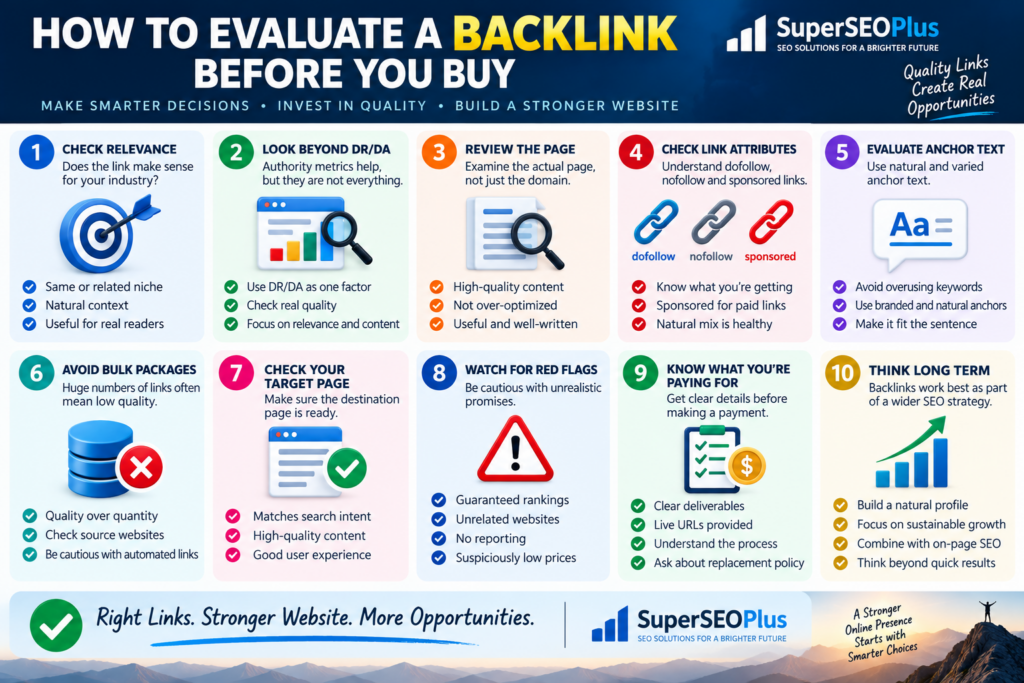
10 factors to evaluate before paying for a backlink, including relevance, page quality, link attributes, anchor text, deliverables and potential red flags.
This is the first thing website owners should understand before spending money.
Google distinguishes between legitimate advertising or sponsorship and links created primarily to manipulate search rankings.
That means paying for advertising or sponsored exposure is not automatically a problem. However, paid links should be handled appropriately, including the correct link attributes where applicable.
For a business owner, the practical lesson is simple:
Do not assume that paying for a backlink automatically makes it a safe or valuable SEO link.
Ask the provider what type of placement you are purchasing and how commercial relationships are disclosed.
2. Don't Judge a Backlink by DR or DA Alone
DR, DA and similar authority metrics are commonly used when backlinks are sold.
You may see offers advertising:
- DR 50+ backlinks;
- DA 60+ websites;
- high-authority backlinks;
- or packages divided according to domain metrics.
These numbers can be useful for research, but they should not be treated as Google's own measurement of backlink quality.
Domain Rating and Domain Authority are third-party metrics created by SEO tool providers.
They can help compare websites, but they cannot tell you everything about a backlink.
Imagine you have two opportunities.
Website A has an impressive authority metric but covers a completely unrelated subject.
Website B has a more modest metric but publishes useful content directly related to your industry.
Looking only at DR or DA could lead you to choose Website A, even though Website B may provide a far more logical contextual placement.
Use authority metrics as one piece of information, not as the entire decision.
3. Check Topical Relevance
One of the simplest ways to evaluate a backlink opportunity is to ask:
“Would this link make sense to someone reading the page?”
Consider a WordPress developer receiving a link from an article about choosing a business website platform.
That connection makes sense.
A local restaurant being mentioned in a city travel guide also makes sense.
A cybersecurity company appearing in a useful article about protecting business networks makes sense.
Now imagine those same businesses receiving links from unrelated pages created primarily to host outbound links.
The context becomes much weaker.
When evaluating high quality backlinks, relevance should therefore be considered alongside authority metrics.
4. Examine the Actual Page, Not Just the Domain
A common mistake when people buy backlinks is checking the domain while ignoring the page where the link will actually appear.
A backlink exists on a page, not simply on a domain.
Look at the page itself.
Ask questions such as:
- Is the content useful?
- Is the topic relevant?
- Does the article appear written for real readers?
- Is the page overloaded with unrelated outbound links?
- Does your backlink fit naturally into the discussion?
- Can visitors reasonably discover the page?
- Does the website appear maintained?
A strong-looking domain metric cannot automatically turn a poor page into a good backlink opportunity.
5. Understand Dofollow, Nofollow and Sponsored Links
The phrase dofollow backlinks appears frequently in backlink packages.
Technically, a standard followed link does not need a special rel="dofollow" attribute.
Other attributes can be used to provide additional information about the relationship behind a link.
For example:
rel="nofollow"can indicate that a publisher does not want to associate normal ranking credit with a link;rel="sponsored"is intended for links involving advertising, sponsorship or other compensation;rel="ugc"can be used for links within user-generated content.
Do not evaluate a backlink solely by asking whether it is “dofollow.”
Context, relevance, page quality, placement and the nature of the relationship are also important.
6. Be Careful With Exact-Match Anchor Text
Anchor text is the clickable text containing a link.
If your target keyword is “link building services,” it may be tempting to request that exact phrase for every backlink.
That is not necessarily a natural way for websites to reference one another.
A backlink profile can contain many types of anchor text:
- brand names;
- website URLs;
- page titles;
- descriptive phrases;
- generic language;
- and keyword-related anchors where they genuinely fit.
The anchor should make sense within the sentence and help the reader understand what they will find after clicking.
For a deeper explanation, read our guide to the importance of anchor text.
7. Don't Be Distracted by Huge Backlink Numbers
Some offers focus heavily on quantity:
100 backlinks. 1,000 backlinks. 10,000 backlinks.
Large numbers can make an offer appear more valuable, but the number alone tells you almost nothing about the quality of those links.
Before buying a large backlink package, ask:
- What kinds of websites are used?
- Are they relevant to my industry?
- Are the links contextual?
- How are the pages selected?
- Will I receive the live URLs?
- What anchor text will be used?
- Are placements automated or manually reviewed?
- What happens if links disappear?
One relevant link from a useful page and thousands of low-value links are not interchangeable simply because both are called backlinks.
8. Check Whether Your Destination Page Is Ready
Sometimes website owners start building links before improving the page receiving them.
That reverses the order.
Before investing in SEO backlinks, examine your target page.
Does it:
- match the user's search intent?
- provide useful and original information?
- load properly?
- work well on mobile?
- have a clear page structure?
- contain appropriate internal links?
- make the next step obvious to visitors?
If the answer is no, improving the page may deserve priority over acquiring more backlinks.
This is particularly important for commercial pages. A backlink might bring a visitor to your website, but the destination page still has to do its job.
For businesses working on a new site, our WordPress website design guide covers many of the foundations worth considering before investing heavily in promotion.
9. Understand the Risks of Automated Link Creation
Automation can make it possible to generate enormous numbers of links quickly.
That does not mean those links are appropriate for an important business website.
Be particularly cautious with packages built around mass creation of:
- forum profiles;
- blog comments;
- bookmark pages;
- low-quality directories;
- automatically generated pages;
- or large networks of unrelated websites.
If you cannot explain why a real website or reader would reasonably want the link, quantity should not make the opportunity more attractive.
It is also worth understanding that inbound links are not automatically beneficial simply because they exist. We discuss this further in Can Any Inbound Linking Hurt My Ranking?
10. Know Exactly What You're Paying For
Before you buy backlinks or hire a provider, make sure the deliverables are clear.
A backlink service should not leave you guessing about what happens after payment.
Depending on the service, useful questions can include:
- How many placements are included?
- What types of websites are targeted?
- Can relevance be considered?
- Who chooses the target pages?
- How is anchor text handled?
- Will I receive a report?
- Will the live URLs be provided?
- Are publisher or placement fees involved?
- Are the links sponsored or otherwise qualified where appropriate?
- What happens if a placement is removed?
Clear expectations make it much easier to compare one backlink service with another.
Red Flags to Watch for When Paying for Backlinks
Not every backlink offer deserves the same level of trust.
Be cautious when the entire sales pitch depends on one or more of the following:
- Guaranteed Google rankings — no provider controls Google's final ranking decisions.
- Huge quantities with no explanation of quality — the number of backlinks does not explain their relevance or usefulness.
- DR or DA as the only quality measure — third-party metrics are useful but incomplete.
- No information about placement — you should understand what type of pages may contain your links.
- Identical keyword-rich anchors everywhere — natural linking patterns tend to contain variation.
- Unrelated websites — relevance should not be ignored simply to reach a target metric.
- No reporting — it becomes difficult to evaluate what you actually received.
- Promises of instant SEO results — organic search performance depends on many variables beyond backlinks.
How Much Does It Cost to Buy Backlinks?
There is no single meaningful price for a backlink.
The cost can depend on factors such as:
- the website or publisher;
- the industry;
- the amount of outreach required;
- content creation;
- editorial requirements;
- placement type;
- campaign size;
- geographic targeting;
- and the provider's service model.
This is why comparing backlink services purely on price per link can be misleading.
A cheap link that has little relevance or value is not necessarily better value than a more carefully selected opportunity.
Likewise, an expensive backlink is not automatically a good backlink.
The important question remains:
What am I receiving for the money?
Looking for a Defined Backlink Package?
If you prefer a backlink service with clearly defined deliverables, you can review my current Fiverr service and package options.
View My Backlink Service on Fiverr
Please review the package details to determine whether the service matches your website and objectives. Backlinks do not guarantee a particular ranking, traffic level or search position.
Buying Backlinks vs. Professional Link Building Services
The terms are sometimes used interchangeably, but they do not always describe the same process.
When someone searches for buy backlinks, the focus is often on purchasing a defined placement or package.
Professional link building services can involve a broader process:
- reviewing the website;
- selecting target pages;
- researching relevant opportunities;
- content creation;
- outreach;
- evaluating websites;
- planning anchor text;
- monitoring placements;
- and reporting.
Neither label tells you enough by itself.
You still need to examine the actual methodology and deliverables.
If you want to understand that process in more detail, read our complete guide to link building services.
Where Does Off-Page SEO Fit In?
Backlinks are part of a broader area usually described as off-page SEO.
But a website's external presence can involve more than traditional backlinks.
Depending on the business, this may also include:
- brand mentions;
- digital PR;
- local business citations;
- industry directories;
- reviews;
- partnerships;
- and other forms of online visibility.
For a local company, for example, accurate business information and local citations can be particularly important. Our local citation building services guide explains that process separately.
The right strategy depends on what the website is trying to achieve.
What About Reciprocal Links?
Websites naturally link to one another, and sometimes two websites may have legitimate reasons to reference each other.
The problem begins when reciprocal linking becomes a system designed primarily to manufacture ranking signals.
Instead of asking, “Can I exchange a link with this website?” start with:
“Would these two links genuinely help the readers of both websites?”
For more background, see our article on reciprocal links and SEO.
Checklist Before You Buy Backlinks
Before paying, work through this checklist.
- ☐ I understand what type of backlink or placement I am purchasing.
- ☐ I have checked the relevance of the website.
- ☐ I am not evaluating the opportunity solely by DR or DA.
- ☐ I understand where the backlink may appear.
- ☐ The target page on my website is ready.
- ☐ The anchor text makes sense in context.
- ☐ I understand the link attributes being used.
- ☐ I am not relying on a ranking guarantee.
- ☐ I know what reporting I will receive.
- ☐ The backlink fits into my wider SEO strategy.
If several of these questions cannot be answered, get more information before spending money.
Frequently Asked Questions About Buying Backlinks
Is it possible to buy backlinks?
Yes. Backlinks and placements are sold through many different commercial arrangements, including advertising, sponsorships, publisher placements and backlink services. The important issues are why the link is being created, its quality and relevance, and whether commercial relationships are handled appropriately.
Does buying backlinks guarantee higher Google rankings?
No. No backlink package can guarantee a specific Google ranking. Search performance depends on many factors, including competition, search intent, content, technical SEO, internal linking, website quality and the broader backlink profile.
Are high DR backlinks always better?
No. A high DR can be useful as one evaluation metric, but it does not automatically mean a backlink is relevant or appropriate. Examine the website, the specific page, context, content quality and placement.
Are dofollow backlinks better?
A normal followed link can be useful, but the link attribute alone does not determine quality. Relevance, context, page quality and placement should also be considered.
How many backlinks do I need?
There is no universal number. Different websites compete in different markets and start with different levels of authority, content and existing backlinks. Focus on building a sensible profile rather than chasing an arbitrary quantity.
Should every backlink use my main keyword as anchor text?
No. Natural backlink profiles can contain branded anchors, URLs, descriptive phrases, page titles and other variations. Repeating the same commercial keyword unnecessarily is not a sensible anchor-text strategy.
Can low-quality backlinks hurt SEO?
Not every questionable backlink will automatically cause a problem, but deliberately creating or purchasing links primarily to manipulate rankings can introduce unnecessary risk. This is one reason quality and methodology matter more than raw backlink counts.
Should I buy backlinks before doing on-page SEO?
Usually, the destination pages should first be worth promoting. If important pages have weak content, technical problems or poor search-intent alignment, addressing those issues may deserve priority before expanding link acquisition.
Is link building only about backlinks?
No. A professional campaign can include strategy, target-page selection, research, outreach, content, placement evaluation, anchor-text planning and reporting. Read our link building services guide for a broader explanation.
Final Thoughts
If you plan to buy backlinks, do not make the decision based only on price, quantity or a domain metric.
Look at the complete picture.
Is the website relevant? Is the page useful? Does the placement make sense? Is the anchor natural? Is the target page ready? Do you understand exactly what you are paying for?
Those questions are much more useful than simply asking how many backlinks a package contains.
A backlink should make sense within your broader SEO strategy rather than exist only because somebody was able to create it.
If you would like to understand the process before choosing a service, start with our complete guide to link building services.
Review My Backlink Service
Looking for a defined backlink package? You can review the current service details, deliverables and available options on Fiverr before deciding whether it is suitable for your website.
No specific Google ranking, traffic level or search position is guaranteed.
About us and this blog
We are a digital marketing company with a focus on helping our customers achieve great results across several key areas.
Request a free quote
We offer professional SEO services that help websites increase their organic search score drastically in order to compete for the highest rankings even when it comes to highly competitive keywords.
More from our blog
See all posts

Recent Posts
- Service-Area Business on Google Maps: How to Set It Up Properly October 20, 2026
- SEO Backlinks Explained: How They Work and How to Earn Them October 19, 2026
- On-Page SEO Checklist: 13 Checks for Every Page October 18, 2026