What is local SEO? It is the set of steps that help your business appear in Google Search and Maps when people look for something near them. If you run a shop, a trade business, a clinic or any service that customers find by searching "near me" or by town name, it is the most direct way to get found online.
This plain-English guide explains what local SEO is, where local results appear, the three factors Google uses to rank businesses, the building blocks you need and a simple plan to get started. Everything is based on Google's own documentation, with clear examples for UK businesses.
In this guide
- What is local SEO? Local SEO explained in plain English
- Where local results appear
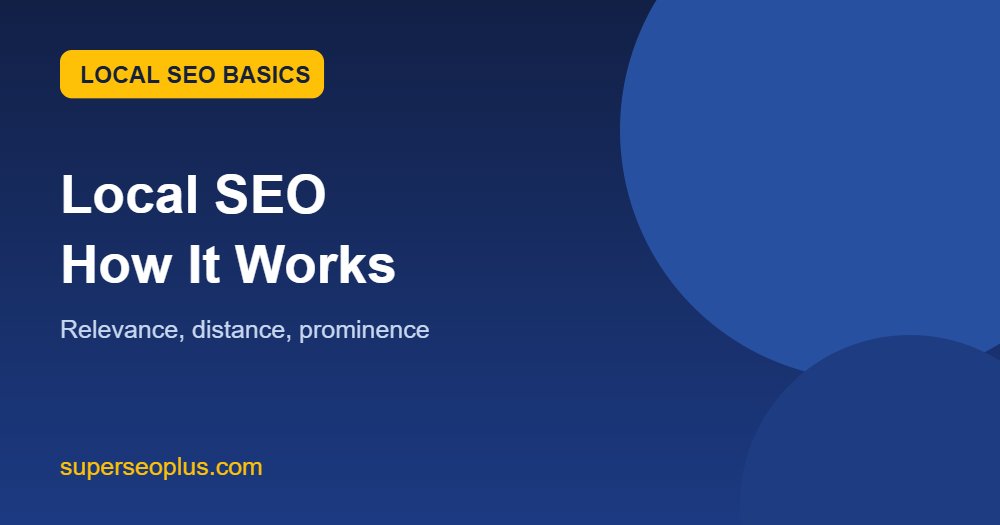
- The three factors Google uses for local ranking
- What is local SEO and who needs it?
- What is local SEO compared with traditional SEO?
- What is local SEO made of? The building blocks
- What is local SEO in action? A simple example for a plumber
- How to get started with local SEO today
- What is local SEO getting wrong? Common mistakes
- How to measure local SEO
- How long does local SEO take, and what does it cost?
- What a good location page contains
- What is local SEO for different types of business?
- How Google chooses between local businesses: two worked examples
- What is local SEO not? Myths worth ignoring
- Keeping your local SEO healthy over time
- How to study your local competitors
- What to ask a local SEO provider before you hire one
- Frequently asked questions
What is local SEO? Local SEO explained in plain English
Local SEO is the work of making your business easier to find when people search for something near them. If someone searches for "dentist in Bristol", "plumber near me" or "wedding photographer Cardiff", Google tries to show businesses that are relevant, close and well regarded. Local SEO is how you give your business the best chance of being one of them.
It differs from general SEO in one important way: location matters. A page about "how to choose a boiler" might be useful to anyone in the world, but a search for "boiler repair" almost always means "boiler repair near me". Google uses location signals to decide which businesses to show, so local SEO focuses on the signals that tell Google where you are, what you do and how trusted you are.
So, what is local SEO in practical terms? It is a mix of managing your Google Business Profile, earning and answering reviews, keeping your details consistent across the web, building location-relevant pages on your website and earning mentions and links from your local community.
Where local results appear
Local SEO affects several places in Google:
- The local pack: the group of business listings, usually with a map, that appears for searches with local intent.
- Google Maps: where people search for businesses and get directions.
- Your Business Profile: the panel that appears when someone searches for your business by name.
- Regular organic results: website pages that rank for local searches such as "electrician in Leeds".
Each has its own mix of signals, but they share the same foundations: accurate information, relevance, reputation and a useful website.
The three factors Google uses for local ranking
Google explains local ranking in its guide to improving your local ranking. It lists three main factors:
- Relevance: how well your profile matches what someone is searching for. Complete, detailed information helps Google understand what you offer.
- Distance: how far your business is from the searcher or from the location named in the search. If the searcher has not shared their location, Google estimates it.
- Prominence: how well known your business is. This is influenced by information from across the web, including links, articles and directories, and by review count and ratings.
Google also says that there is no way to request or pay for a better local ranking. That is why local SEO is about earning your position through accurate information and genuine reputation rather than buying it.
Understanding the three factors helps you prioritise. You cannot change where you are, so you improve relevance (profile and website content) and prominence (reviews, citations and links).
What is local SEO and who needs it?
Any business that serves customers in a particular area can benefit:
- Shops, cafés, restaurants and salons that rely on people finding them nearby.
- Trades and home services such as plumbers, electricians, roofers and cleaners.
- Professional services such as solicitors, accountants, dentists and physiotherapists.
- Agencies and consultants who want to be found by local clients, even if they also work remotely.
- Multi-location businesses that need each branch to be visible in its own area.
Online-only businesses that serve a national or global audience usually need general SEO more than local SEO, though a local presence can still help if you have a physical address or serve local customers.
What is local SEO compared with traditional SEO?
| Local SEO | Traditional (national) SEO | |
|---|---|---|
| Goal | Be found by nearby customers | Be found by customers anywhere |
| Key assets | Business Profile, reviews, citations, location pages | Website content, links, technical performance |
| Competition | Businesses in your area | Websites from across the country or world |
| Typical keywords | "plumber in Leeds", "dentist near me" | "how to fix a leaking tap", "best project management software" |
| Speed of results | Often faster for niche local terms | Usually slower for competitive terms |
The two overlap: a local business still needs a fast, mobile-friendly, helpful website. Local SEO adds the profile, review and location layers on top.
What is local SEO made of? The building blocks
1. Your Google Business Profile
This is the single most important local asset. Verify it, use your real business name, choose accurate categories, list services, add photos and keep hours current. Our local SEO service includes profile optimisation, and you can follow the principles in Google's guidelines for representing your business.
2. Reviews
Reviews are a major part of prominence. Ask every satisfied customer, make it easy with a link or QR code, never offer incentives, and reply to every review in a professional, short and non-promotional way. Google's advice is that offering free or discounted goods in exchange for reviews is strictly prohibited.
3. Citations and consistency
A citation is a mention of your business name, address and phone number on another site, such as a directory. Keeping these details consistent helps Google trust them. Read our guide to local citation building for more detail.
4. Location and service pages
Your website should have a clear page for each main service and, where relevant, each area you serve, with real, useful content. Avoid thin, copy-and-paste pages that only swap the town name.
5. On-site signals
Put your name, address and phone number on your contact page, embed a map if you have a premises, and add LocalBusiness structured data. Google's documentation lists the business name and address as required properties and recommends details such as opening hours, telephone number and URL.
6. Local links and mentions
Links from local organisations, suppliers, charities, events and press show that real people know you. Choose genuine opportunities over bought links, which breach Google's spam policies.
7. Technical health
Because Google uses the mobile version of your pages for indexing, your site must work well on phones. Aim for good Core Web Vitals and make sure pages load quickly and are easy to use.
What is local SEO in action? A simple example for a plumber
This is an illustration, not a real client. Imagine a plumber called Sam who covers three towns. Before local SEO, Sam has a basic one-page website, an unverified profile with wrong opening hours and six reviews from two years ago.
With a local SEO plan, Sam verifies the profile, fixes the opening hours, lists services in customer wording, adds photos of recent jobs and a branded van, and sets up the service areas. Sam asks every customer for a review using a QR code on invoices, and replies to each one. The website gets a clear page for boiler repair, emergency plumbing and bathroom fitting, each with real project photos and testimonials. Sam is listed consistently in a handful of respectable directories and in a local trades association page that links to the site.
Over the following months, more people see Sam's profile, more call directly from it, and the quality of enquiries improves because the pages and profile explain exactly what Sam does. Nothing here is a trick. It is the same work you would do for any business: be accurate, be useful, be visible and be consistent.
How to get started with local SEO today
- Search for your business and your main services in your area. Note what appears, what competitors do well and where your profile is missing.
- Verify and complete your Business Profile. Fix the name, address, hours, phone, categories and services.
- Collect reviews. Create your review link and add it to emails, invoices and receipts.
- Check consistency. Search for your phone number and address and fix any wrong or duplicate listings.
- Improve your website. Build or improve one page per main service, add your contact details and check mobile usability and speed.
- Track results. Record calls, direction requests and enquiries each month.
You do not need to do everything at once. Work through the list in order and keep going.
What is local SEO getting wrong? Common mistakes
- Stuffing keywords into the business name. This breaches Google's guidelines and risks suspension.
- Using a virtual office or mailbox as your address.
- Creating duplicate profiles for the same business.
- Neglecting reviews or buying them.
- Inconsistent details across your website, profile and directories.
- Thin location pages with identical text across many towns.
- Ignoring mobile speed and usability.
- Expecting instant results.
How to measure local SEO
Look at the actions that matter to your business rather than rankings alone:
- Calls, direction requests and website clicks from your Business Profile
- Impressions and clicks from Google Search Console for local queries
- Enquiry forms and phone calls recorded in Google Analytics or your call tracking
- New reviews and your average rating
Rankings in local results change by location and device, so do not rely on one personal search. Track trends over several months. Google's SEO starter guide notes that changes can take from a few hours to several months to show, and recommends waiting a few weeks before judging.
How long does local SEO take, and what does it cost?
Some local fixes show quickly, such as correcting wrong hours or adding a missing category. Building prominence through reviews and links takes longer, usually months. Costs vary with competition and scope. You can always ask us for a free quote.
What a good location page contains
A location or service-area page should help a real person in that area decide to contact you. A page that only repeats "plumber in Town A" fifty times will not do that. Use this outline as a starting point:
- A clear heading and opening: say what you do and where you do it, in natural language.
- Specific services for that area: list what you offer there and any limits, such as call-out times or minimum jobs.
- Local proof: photos of jobs in the area, testimonials from local customers and mentions of local projects where you have permission to name them.
- Practical details: opening hours, response times, parking or access information if customers visit, and how to book.
- Local knowledge: common issues in the area, such as older housing stock, flood risk, planning rules or seasonal demand, if you really know them.
- Contact options and a map: a clear phone number, a short form and a map if you have a premises.
- Frequently asked questions: real questions from customers in that area.
Google's guidance on helpful content warns against mass-produced pages and content that exists mainly to attract search visits. If you cannot add something genuinely different for a town, cover it on a single wider "areas we cover" page instead.
What is local SEO for different types of business?
Shops, cafés and restaurants
Customers want to know whether you are open, whether you have what they need and how to get there. Keep hours and holiday hours accurate, upload current photos of your products, menu and interior, and make sure your website and profile agree. Reviews often mention atmosphere and service, so reply thoughtfully.
Trades and home services
Customers are choosing someone to trust in their home. Photos of real work, branded vehicles, accreditations and recent reviews matter a great deal. Choose realistic service areas and use clear service names in your profile and on your website.
Professional services
For solicitors, accountants, dentists and similar services, trust and expertise are central. Show qualifications, explain processes in plain language, answer common questions and keep reviews and replies professional. Never share confidential details in replies.
Multi-location businesses
Each location needs its own profile, its own page on your website and consistent details. Avoid duplicating text across locations. Make sure each profile links to the right location page.
Agencies and consultants
If you work mostly online but have a real office, you can still build local visibility to attract nearby clients. Combine a complete profile with case studies, local networking and links from regional business organisations.
How Google chooses between local businesses: two worked examples
These examples are simplified to show how the three factors interact. They are not guarantees about any specific search.
Example 1: "emergency plumber" searched from the city centre. Google will probably favour businesses whose profiles clearly describe emergency plumbing (relevance) and who are close to the searcher (distance). Among those, the one with more genuine reviews, a strong rating and a recognised web presence (prominence) is likely to appear higher. A plumber who is slightly further away but much better known can still outrank a closer, unknown competitor.
Example 2: "accountant for sole traders" searched from a village. Fewer businesses are physically nearby, so distance matters less and relevance and prominence matter more. A firm that has a specific service page, clear profile services and good reviews can outperform a larger firm that only lists "accountant".
The lesson is that you cannot control distance, but you can control how clearly you describe what you do and how credible you look.
What is local SEO not? Myths worth ignoring
- "You can pay Google to rank higher locally." Google says there is no way to request or pay for a better local ranking.
- "More categories means more visibility." Google recommends the fewest and most specific categories that describe the business.
- "Add every town to your service area." Listing places you do not really serve does not help and may harm credibility.
- "Keywords in your business name are a shortcut." They are a common cause of suspension.
- "Reviews alone will fix everything." Reviews matter, but relevance, a helpful website and accurate details matter too.
- "Local SEO is a one-time set-up." Hours change, competitors improve and reviews keep arriving. It needs routine attention.
Keeping your local SEO healthy over time
Local SEO is more like gardening than building. After the initial work, a short routine keeps everything in good shape:
- Weekly: reply to new reviews, check for questions or messages and add a recent photo.
- Monthly: review Business Profile performance, check hours and details, publish an update and look for new directory or local link opportunities.
- Quarterly: audit your website pages, check for broken links and outdated content, and compare your visibility with competitors.
- Whenever something changes: update your profile, website and directories together so details stay consistent.
If you would like help setting this up, you can request a free SEO analysis and we will show you where your biggest local opportunities are.
How to study your local competitors
You cannot improve in a vacuum, so spend an hour looking at who appears for the searches that matter to you. Search for your main service and town, ideally in a private browsing window and from a location close to your customers. Note which businesses appear in the local pack and in the organic results beneath it.
For each competitor, look at:
- Their profile: categories, services, photos, number of reviews, rating and how often they reply.
- Their website: do they have a dedicated page for the service you are searching for? How helpful and specific is it?
- Their mentions: which directories, associations and local sites list them?
- Their gaps: what do customers complain about in their reviews that you do better?
The aim is not to copy but to understand the standard you need to meet and find the angles where you can be more useful. If a competitor has hundreds of reviews and you have ten, you will need a longer-term review plan. If nobody has a good page for a specific service, that is an opportunity.
What to ask a local SEO provider before you hire one
If you decide to get professional help, Google's guidance on hiring an SEO is a good checklist. Ask whether they can show examples of past work, whether they follow Google's guidelines, what results they expect and in what timeframe, how they will measure success and whether they will explain every change they make. Be wary of guarantees, secret methods and offers that sound too good to be true.
For local work in particular, ask:
- Who will own the Google Business Profile and website accounts? You should.
- How do you collect reviews without breaking Google's rules?
- How will you decide which locations and services to target?
- What will you report each month, and will it include calls and enquiries?
- What happens to the work if we stop working together?
A good provider will answer plainly and welcome the questions.
Frequently asked questions about local SEO
What is local SEO in simple terms?
It is the process of helping your business appear in Google Search and Maps when people look for products or services near them. It covers your Business Profile, reviews, directory listings, website pages and local links.
What is the difference between local SEO and Google Ads?
Local SEO earns organic visibility in the map and search results. Google Ads is paid advertising. Google states that you cannot pay for a better organic local ranking, and advertising does not change organic results.
Do I need a website for local SEO?
A Business Profile can work without a website, but a website gives customers detail and gives Google more signals about what you do. For most businesses, a good website significantly improves results.
How do I rank in the local pack?
Google says relevance, distance and prominence matter. Complete your profile, choose accurate categories, collect genuine reviews, keep details consistent and build a helpful website.
Does local SEO work for service-area businesses?
Yes. You can hide your address and list the areas you serve. Choose realistic areas and make sure your website explains the services you offer in each.
How often should I update my local SEO?
Check your profile monthly, reply to reviews weekly if possible, update hours whenever they change and review your website pages every few months.
Is local SEO worth it for a small business?
For many local businesses it is one of the most cost-effective ways to attract nearby customers, because people searching locally often have strong intent to buy or book.
Want help getting found locally?
SuperSEOPlus helps UK businesses improve their Google Business Profile, reviews, citations and local website pages. Get a free SEO quote or request a free SEO analysis.
About us and this blog
We are a digital marketing company with a focus on helping our customers achieve great results across several key areas.
Request a free quote
We offer professional SEO services that help websites increase their organic search score drastically in order to compete for the highest rankings even when it comes to highly competitive keywords.
More from our blog
See all posts






Recent Posts
- What Is Local SEO? A Plain-English Guide for UK Businesses October 15, 2026
- Technical SEO Checklist: 14 Checks for a Healthy Website October 15, 2026
- Benefits of Digital Marketing: 12 Easy Wins for UK Businesses October 14, 2026