Can You Do Local SEO Without a Website? What Works and What Doesn't
- October 22, 2026
- Local SEO
Yes, you can do local SEO without a website. A verified Google Business Profile can appear in Google Maps and local search results with no website at all, and many tradespeople, home-based services and small shops get calls this way. But a website gives you more to rank, more room to build trust and more control, so going without one limits how far local SEO can take you.
This article explains what works, what does not, and how to get the most from a Business Profile when you do not have a site. It also covers the cheap, sensible next step if you want to add one later. For Google's own explanation, see its tips to improve your local ranking.
Table of Contents
Local SEO without a website: what you can do
1. Build a complete Google Business Profile
Everything in your profile can be filled in without a site: categories, services, hours, photos, description, service area and contact details. This is the biggest single lever for local visibility. Our Business Profile optimisation checklist covers every field.
2. Collect and answer reviews
Reviews are part of Google's prominence signals and they persuade people to call. They need no website. See how to get Google reviews.
3. Use Google's free website option, with caution
Google has offered simple website builders linked to Business Profiles in the past, but the availability of this feature has changed over time. Check your profile for what is currently offered rather than relying on it, and have a plan for an independent site.
4. Keep your details accurate across directories
Without a website, directories and social pages do more of the work of showing you exist. Accurate listings help customers and reduce confusion. See NAP consistency explained and local citation sites for UK and US businesses.
5. Use social profiles as supporting pages
A well-kept Facebook or Instagram page with your trading name, area, services, contact details and photos can give customers somewhere to check you out. They are not a substitute for a website you control, but they help.
What you cannot do without a website
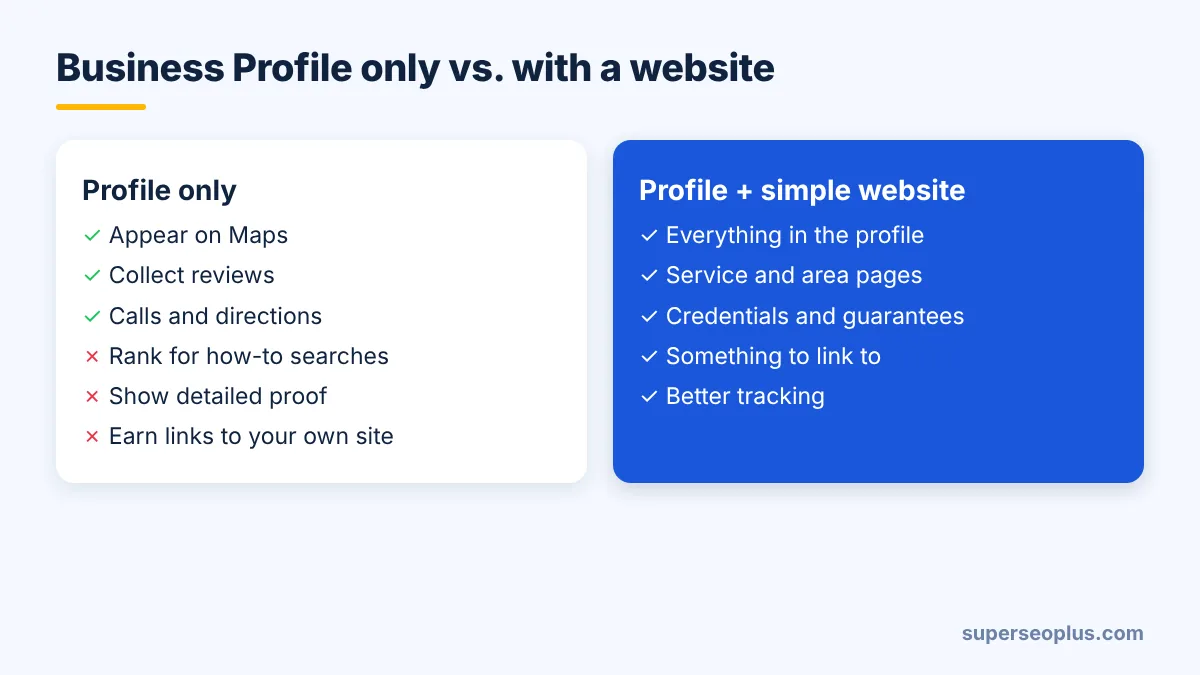
- Rank for many informational searches. Questions like "how much does a boiler service cost" need a page to rank.
- Show detailed proof. Case studies, credentials, guarantees and pricing guidance need space.
- Earn website links. Google mentions links from other websites as part of prominence. With no site, you have nothing for others to link to.
- Control the message. Third-party platforms can change rules, fees or visibility.
- Measure properly. Website analytics tell you far more about what customers do.
How hard is it to rank without a website?
That depends on competition. In a small town with few competitors, a strong profile and good reviews can be enough. In a competitive city, competitors with good websites, reviews and links usually have an edge. Google states that relevance, distance and prominence drive local rankings, and a website supports both relevance and prominence. Our guide to ranking higher on Google Maps explains each factor.
A sensible step-by-step plan
- Verify and complete your Business Profile. If it is not showing, start with why a business may not show on Google Maps.
- Choose accurate categories and services.
- Add real photos of your work, premises or team.
- Collect reviews steadily and reply to them.
- Make your details consistent across the main directories.
- Add a simple website when you can: one page with services, area, contact details and credentials is a big step up.
What a minimum viable website needs
- Business name, address (or service area) and phone number, matching your profile exactly.
- A short description of each main service.
- A few real photos and a handful of genuine testimonials you have received.
- Credentials, insurance and guarantees where relevant.
- Clear call and contact options that work on mobile.
It does not need to be elaborate to be useful. If you need help with that next step, see our approach to affordable WordPress website design.
Building Your Online Presence Without a Website?
Without a website, accurate directory listings do more of the work of showing customers you exist. If you want help creating them, explore our Google Maps citations service on Fiverr. It is an optional extra and works best alongside a complete Business Profile.
Mistakes to avoid when you have no website
- Leaving the website field blank without any other online presence at all.
- Using a social profile as your "website" with out-of-date details.
- Inconsistent phone numbers across directories and social pages.
- Paying for "guaranteed" Maps rankings. Nobody can guarantee them.
Local SEO without a website: the short version
Local SEO without a website is possible, but it has a ceiling. A complete Business Profile, steady reviews and accurate listings are the core of local SEO without a website. When you are ready, a simple site lifts that ceiling. Until then, treat local SEO without a website as a solid starting point.
Frequently asked questions
Can I rank on Google Maps without a website?
Yes, you can appear and rank, but a website supports relevance and prominence, so competitive areas are harder.
Is a Facebook page enough?
It helps as a supporting profile, but you do not control the platform, and it gives you less room to rank and convert.
How soon should I get a website?
If local SEO matters to your growth, sooner is better. Even a simple one-page site improves what you can show and measure.
Not sure what your next step is? Request a free SEO analysis.
About us and this blog
We are a digital marketing company with a focus on helping our customers achieve great results across several key areas.
Request a free quote
We offer professional SEO services that help websites increase their organic search score drastically in order to compete for the highest rankings even when it comes to highly competitive keywords.
More from our blog
See all posts
Recent Posts
- How to Rank Higher on Google Maps: What to Fix First October 22, 2026
- Can You Do Local SEO Without a Website? What Works and What Doesn't October 22, 2026
- Service-Area Business on Google Maps: How to Set It Up Properly October 20, 2026