Local Citation Sites for UK and US Businesses: Which Are Worth Using?
- October 23, 2026
- Local SEO
The local citation sites worth using are the ones that are relevant to your business, reputable, and accurate for you: major platforms (Google, Apple, Bing, Facebook), a handful of respected general directories in your country, and industry or location-specific listings. A small number of accurate listings on the right sites beats hundreds of low-quality ones.
This guide gives a practical shortlist for UK and US businesses, explains how to choose, and shows how to avoid the usual traps. We do not claim that listing on these sites will raise your Google Maps ranking. Google's own documentation on local ranking does not list directories, and the benefit of citations is an industry observation, not a documented rule. They are best treated as accurate, supporting information. For Google's own explanation, see its tips to improve your local ranking.
Table of Contents
Which local citation sites are worth your time?
- Relevance: relevant to your trade, your location or both.
- Real users: real people actually use it to find businesses.
- Editorial standards: it moderates listings and does not accept anything.
- Control: you can claim, edit and later update your listing.
- Cost: free or reasonable, with no hidden contracts.
Sites that exist only to host thousands of listings, with no visitors and no moderation, rarely help. If you want the background on what citations are, see NAP consistency explained and local citation building services.
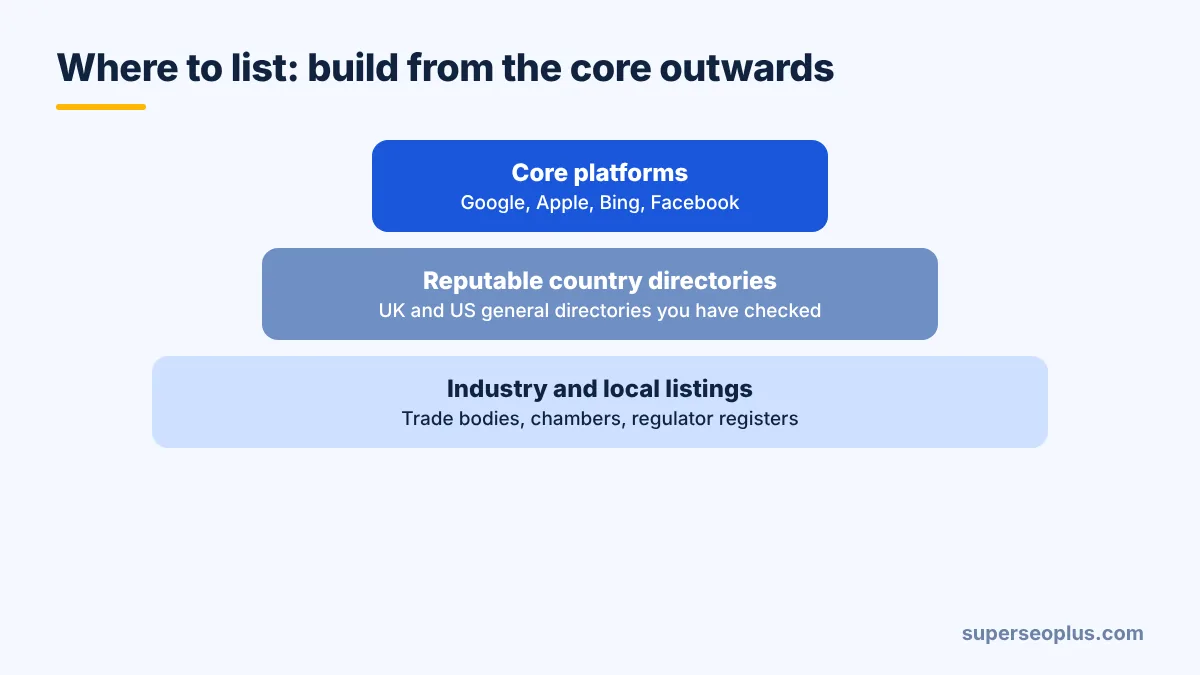
Start here: the platforms that matter for everyone
- Google Business Profile: the most important listing. See our optimisation checklist.
- Apple Business Connect: feeds Apple Maps.
- Bing Places for Business: feeds Bing and some other search tools.
- Facebook business page: widely used by customers.
UK listings to consider
Availability and popularity change, so check that each site is active and relevant before you submit.
- Yell.com: a long-standing UK business directory.
- Thomson Local: a UK directory with business listings.
- Trusted trade platforms such as Checkatrade or similar, if you qualify and the fees suit you.
- Trustpilot for reviews, if it suits your business.
- Local chamber of commerce and business association listings.
- Industry bodies and scheme finders where you hold genuine membership, such as trade association "find a member" pages.
- Local council and community directories where they exist.
US listings to consider
- Yelp: widely used in many US cities, though its policies on reviews are strict.
- Better Business Bureau: relevant for many service businesses.
- Angi and similar home-service platforms, if their lead model suits you.
- Nextdoor business pages for local businesses.
- Chamber of commerce listings.
- Industry association directories and licensing board lookups where relevant.
- Major data aggregators, which supply information to many other sites. Check their current pricing and terms.
Industry-specific listings
These can be the most valuable of all, because they attract customers who are already looking for your kind of business:
- Trades: scheme registers, trade association directories and reputable trade platforms.
- Healthcare and dental: regulator registers and professional bodies.
- Legal and financial: regulator and professional body registers.
- Hospitality: review and booking platforms.
How many citations do you need?
There is no official number. Some studies from local SEO agencies report differences between businesses with more and fewer citations, but those are observations rather than Google guidance, and they cannot prove cause. A sensible approach:
- Cover the core platforms accurately.
- Add the most relevant industry and local listings.
- Check what competitors are listed on for ideas, not to copy blindly.
- Stop when additional listings are low quality.
How to build a citation the right way
- Write down your master record (name, address, phone, website, hours, categories).
- Search for an existing listing first. Claim and edit it rather than creating a duplicate.
- Choose the most accurate category on each site.
- Use the same details every time.
- Record logins and URLs in a spreadsheet.
- Check that the listing went live and displays correctly.
What to avoid
- Bulk packages promising thousands of listings. They often use sites with no real audience.
- Unmoderated, auto-generated directories.
- Paying for listings you cannot later edit or remove.
- Using a virtual address or keyword-stuffed name just to fill in forms.
- Ignoring duplicates. They confuse customers and can cause problems for profiles.
DIY or get help?
Doing it yourself is feasible if you have a few hours and want to learn the process. Many owners prefer to hand it over, especially when they have old duplicates to resolve or several locations. If you do hire someone, read our guide to choosing a citation building service and ask what sites they will use, how they check the results and whether you get account access.
Want Someone to Handle the Listings for You?
If you would rather not claim and check dozens of listings yourself, explore our Google Maps citations service on Fiverr. We focus on accuracy and relevance, and we make no ranking promises.
Where this fits in the bigger picture
Citations are one supporting piece of local visibility. Reviews, a complete profile and a good website usually matter more. See how to rank higher on Google Maps for a prioritised view, and what local SEO is for the fundamentals.
Local citation sites: key takeaways
Local citation sites are worth using when they are relevant, reputable and accurate for your business. Start with the core platforms, then add the best local citation sites for your country and trade. Avoid bulk lists of local citation sites with no real audience, and review your local citation sites once a year. Quality beats quantity when choosing local citation sites.
Frequently asked questions
Do citations help me rank on Google Maps?
They may support local visibility by keeping your details accurate, but Google does not publish them as a ranking factor and they cannot guarantee a position.
Are free citation sites worth it?
Yes, if they are relevant and reputable. Cost does not decide quality.
Do I need the same citation sites in the UK and the US?
No. Some platforms are global, but many directories are country-specific. Choose sites that serve the market you operate in.
How long do citations take to appear?
It varies from days to weeks, and some sites require verification. Check each listing after submitting.
Want help reviewing which listings your business actually needs? Request a free SEO analysis.
SuperSEOPlus Editorial is the editorial byline for articles published on SuperSEOPlus. It is a publication byline, not an individual author. The guides cover SEO, local SEO, link building, content marketing, WordPress and digital marketing, and aim to explain how these topics work in practical terms. Where an article recommends third-party tools or products, any affiliate relationship is disclosed in the article. We do not guarantee rankings, traffic or income.
About us and this blog
We are a digital marketing company with a focus on helping our customers achieve great results across several key areas.
Request a free quote
We offer professional SEO services that help websites increase their organic search score drastically in order to compete for the highest rankings even when it comes to highly competitive keywords.
More from our blog
See all posts


Recent Posts
- WordPress Redirect Chains: Build a Safe URL Repair Map November 9, 2026
- Duplicate Title Tags in WordPress: Identify Which Problem You Have November 7, 2026
- Sitemap Couldn’t Fetch in WordPress: Find the Failing Request November 5, 2026