

Local Citation Building Services: Costs, Benefits & How to Choose
- September 18, 2026
- Local SEO
Local Citation Building Services: A Practical Guide for Local SEO
Local citation building services take one of the most repetitive parts of local SEO off your plate: finding relevant business directories and platforms, submitting accurate company information, checking what already exists, and keeping track of what was actually submitted or published.
But citation services are not all the same. Some packages focus only on creating new business listings. Others may include citation audits, correcting outdated information, dealing with duplicate listings, or ongoing citation management. Knowing which problem your business actually has can prevent you from paying for work you don't need.
If you're comparing local citation building services, don't judge an offer by the number of submissions alone. Start with three questions: Where will my business be listed? What existing problems will be addressed? What will the final report show?
This guide explains what local citation building involves, how citations fit into local SEO, what Google Map citations mean, how to evaluate citation quality, and what to look for before outsourcing the work.
What Are Local Citations?
A local citation is an online reference to a business and its identifying information. This commonly includes the business name, address, and phone number—often referred to as NAP. A citation may also include the website, opening hours, business category, service area, description, or other company details.
Local citations can appear on business directories, industry platforms, membership listings, local websites, news articles, chambers of commerce, professional associations, and other relevant online sources.
A citation does not necessarily need to contain a clickable website link. A backlink and a citation can appear together, but they describe different things: a backlink points to a web page, while a citation identifies or references a business.
Structured Citations vs. Unstructured Mentions
| Type | What It Looks Like | Example |
|---|---|---|
| Structured citation | Business information organized into dedicated fields. | A directory profile containing a business name, telephone number, address, website, and category. |
| Unstructured mention | Business information appearing naturally within editorial or other free-form content. | A local newspaper article mentioning a shop and giving its street address. |
Not every passing brand mention contains a complete NAP record. The practical question is whether the information helps identify the correct business. It is also important to recognize that earning editorial coverage in a local publication requires different work from completing a business-directory form. A standard citation package should not automatically be assumed to include both.
What Do Local Citation Building Services Actually Do?
Local citation building is the process of finding appropriate business-listing opportunities, checking whether a company already appears on those platforms, and submitting accurate information where a new listing is appropriate.
Depending on the provider and package, a local citation building service may also include verification, tracking approval status, identifying duplicate listings, correcting inaccurate records, or documenting completed work.
However, citation creation, auditing, cleanup, and ongoing management are different services.
| Service | Main Job | What to Establish Before Ordering |
|---|---|---|
| Citation audit | Identify existing records, errors, duplicates, and gaps. | Which sources are checked and whether you receive a prioritized action list. |
| Citation creation | Create appropriate listings where records are missing. | Which platforms qualify and what counts as a completed submission or listing. |
| Citation cleanup | Address inaccurate records and unwanted duplicates where possible. | Whether correction requests, follow-up, and unresolved cases are included. |
| Citation management | Monitor and update listings over time. | Which platforms are covered, whether fees recur, and what happens if the service ends. |
For example, if your business changed its telephone number two years ago, buying 50 new citations doesn't necessarily solve the problem if important existing listings still display the old number. In that situation, an audit and cleanup may deserve attention before additional citation creation.
Prefer to Have the Citation Work Handled for You?
If you already know you want to outsource the research and submission work, I offer a map and local citation service through Fiverr.
You can review the current package, deliverables, pricing, and service details before deciding whether it matches what your business needs.
Who Should Consider a Local Citation Building Service?
Not every local business needs to outsource citation work. But a citation building service can make sense when the main problem is time, scale, research, or repetitive manual submission work.
You may want to consider outsourcing citation building if:
- You are establishing a new local business. You may need to build an initial presence on appropriate general, local, and industry-specific platforms.
- Your business has few relevant listings. Researching suitable opportunities and completing submissions manually can consume considerable time.
- You are entering a new geographic market. Different countries, cities, and industries may have different useful directories and business platforms.
- You manage multiple locations. Keeping location-specific information organized becomes increasingly important as the number of locations grows.
- You run an agency. Outsourcing repetitive citation work can free internal time for strategy, content, client communication, and other SEO work.
- You already know which citations are missing but don't have time to create them. This is one of the clearest cases for outsourcing citation creation.
On the other hand, if your main problem is an old address, outdated telephone number, incorrect company name, or numerous duplicate profiles, look carefully at whether you need citation cleanup rather than simply more citations.
Do Local Citations Still Matter for SEO?
Local citations can still be useful as part of a broader local SEO strategy, particularly for maintaining accurate business information and establishing a presence on platforms relevant to your customers, industry, or location.
What they should not be treated as is a guaranteed shortcut to a particular Google Maps or local search position.
Google describes local results primarily in terms of relevance, distance, and prominence. Google also discusses factors such as links and reviews when explaining prominence. It does not publish a formula stating that a particular number of citations guarantees a particular local ranking.
See Google's guidance on improving local ranking.
Google also explains that business information can come from several sources, including publicly available web content, licensed third-party data, users, and information supplied by business owners.
See Google's explanation of how it sources business information.
The practical takeaway is straightforward: accurate, useful business listings are worth having, but citation building should be treated as one part of local SEO rather than the entire strategy.
A broader local SEO strategy can also involve your Google Business Profile, website relevance, service and location content, customer reviews, links, business prominence, accurate contact information, and the quality of the overall customer experience.
Citation work also cannot change the physical distance between a business and a searcher. If the website doesn't clearly explain what the company offers, or if the Google Business Profile is incomplete, adding more directory submissions should not automatically be the first priority.
What Are Google Map Citations?
"Google Map citations" is an SEO industry term that can be used to describe different types of business mentions or map-related placements intended to support a business's local online presence. It is not a label that should be assumed to describe one standardized deliverable.
Some providers use Google map citations to describe business directory listings. Others may use the phrase for custom map pins, map-based placements, embedded maps, or related work.
When comparing offers for Google map citations for local SEO, find out exactly what you are purchasing.
An offer might involve:
- Business profiles on independent directories or listing platforms.
- Corrections to existing business records.
- Local or industry-specific business listings.
- Custom map content or map-based placements.
Those deliverables are not automatically interchangeable. A collection of map pins is not the same thing as a collection of useful business directory profiles, and creating map content does not create genuine business locations.
Before ordering a map citation package, ask for examples of the types of placements involved and find out what the final report will contain. The phrase "Google Map citations" by itself does not establish the quality, relevance, or SEO effect of the work.
NAP Consistency: Get the Important Facts Right
NAP stands for Name, Address, and Phone number. NAP consistency is about keeping the core information identifying your business accurate across relevant listings.
Creating one approved master business record before starting citation work makes submissions easier and reduces avoidable mistakes.
However, consistency should not be confused with obsessing over harmless formatting differences.
Consider this fictional example:
BrightFlow Plumbing
27 King Street
Manchester
0161 XXX XXXX
| Variation Found Online | What to Consider |
|---|---|
| "27 King St." instead of "27 King Street" | Confirm that it refers to the same address. An abbreviation alone is not evidence of a ranking problem. |
| "Bright Flow Plumbing Ltd" | Confirm the business's actual trading name before changing anything. Spacing or a legal suffix does not automatically mean it is a different company. |
| An old or disconnected phone number | Prioritize correction because potential customers may be unable to contact the business. |
| A previous street address | Request an update and check whether another record represents an unwanted duplicate. |
| Another company's website | Correct the URL and check the rest of the record for mistaken identity. |
The important distinction is between cosmetic variation and genuinely incorrect business information.
For Google Business Profile, use the business name used in the real world and follow Google's location and representation requirements. Service-area businesses that do not receive customers at their address should follow Google's rules for address visibility.
See Google's guidelines for representing your business.
Do not publish a private residential address across directories merely to fill every possible NAP field. Check each platform's rules and available service-area or address-display settings.
How Does Local Citation Building Work?
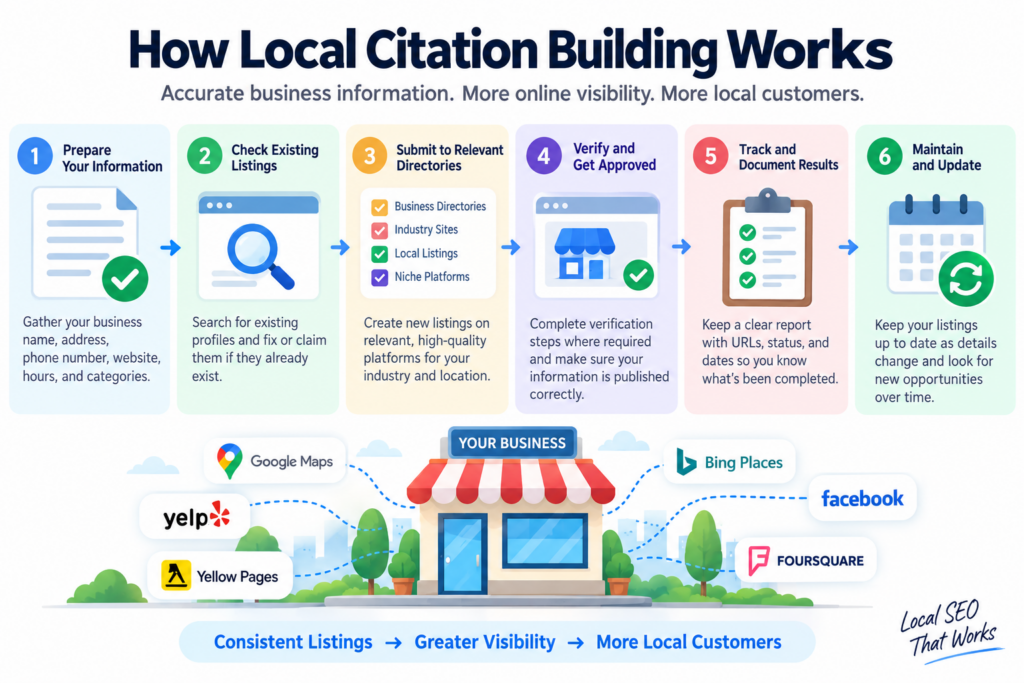
1. Prepare an Approved Business Record
Gather the information that may be needed during submissions, including the trading name, website, telephone number, address or service-area details, opening hours, business description, categories, and approved images.
Keep separate records for genuinely different locations. Decide which details can be made public and who will handle any owner verification requirements.
2. Search for Existing Listings
Before creating another listing, search for existing records using the business name, phone number, previous business names, and old addresses where relevant.
If an appropriate profile already exists, claiming or correcting that listing may make more sense than creating another one.
3. Choose Citation Sources for a Reason
A useful shortlist can include established general directories as well as platforms relevant to your country, city, profession, or industry.
Depending on the business, that may include local organizations, professional associations, chambers of commerce, niche directories, or other platforms where the company genuinely qualifies for a listing.
There is no single Google map citations list that makes sense for every company. The fact that a website accepts business submissions does not automatically make it relevant to your business.
4. Submit, Claim, or Correct the Listing
Use the approved business information and follow the rules of each platform. Where verification is required, complete it using business-controlled accounts whenever practical.
If a platform supports delegated access, that is preferable to unnecessarily sharing the password for a primary business email account.
5. Check What Was Actually Published
Once a listing is live, check the business name, telephone number, website, category, address visibility, and other important information.
A submission confirmation is evidence that a form was submitted. It is not necessarily evidence that the listing has been approved and published.
6. Keep a Useful Completion Report
A good handover report should make it possible to see what happened without repeating the entire project.
| Report Field | What It Should Tell You |
|---|---|
| Platform and profile URL | Where the actual listing can be inspected. |
| Action | Whether the work involved a new submission, claimed profile, correction, or duplicate request. |
| Status and check date | Whether the listing is live, pending, rejected, or unresolved as of a specific date. |
| Information checked | Name, contact details, website, category, and public address settings where relevant. |
| Ownership | Which account controls future access. |
| Follow-up | What remains outstanding and who is responsible for the next action. |
Citation Quality vs. Quantity: Are More Citations Better?
More citations are not automatically better. The usefulness of another listing depends on where it appears, whether the platform is appropriate for the business, whether the information is accurate, and whether the listing serves a genuine purpose.
Before adding another citation, ask:
- Does this platform serve my country, city, industry, or target market?
- Does my business genuinely meet its eligibility requirements?
- Are the profiles useful and accessible to potential customers?
- Can inaccurate information be corrected later?
- Does an appropriate listing already exist?
- Is there a clear reason for creating this particular citation?
A relevant trade or local directory may deserve attention even if its audience is smaller than that of a large general directory. Conversely, an unrelated site does not become valuable simply because an SEO tool assigns the domain a high numerical metric.
A sensible approach is to correct important existing records, establish suitable core listings, and then require a reasonable purpose for additional placements rather than chasing the largest possible citation count.
Manual vs. Automated Citation Building
Local citation building can be performed manually, through automated distribution platforms, or with a combination of both approaches.
Manual submission can provide more control over individual source selection and unusual listing requirements. Automated systems can reduce repeated data entry and distribute updates across supported networks more quickly. Neither approach eliminates the need for accurate information and quality control.
| Consideration | Manual Citation Building | Automated Distribution / Management |
|---|---|---|
| Control | Allows individual platform selection and handling of unusual fields. | Depends on the provider's supported network and available fields. |
| Speed | Requires work on individual platforms. | Can distribute information across supported platforms relatively quickly. |
| Accuracy | Depends on research, data entry, and checking. | Can distribute consistent information efficiently—but incorrect input can also spread efficiently. |
| Cost structure | May be priced by project, package, or submission count. | May involve subscription or distribution fees, depending on the provider. |
| Scalability | Requires more manual work as locations increase. | Can be useful for businesses managing many locations. |
| Potential fit | Selective placements and cases requiring individual attention. | Repeated updates across a defined supported network. |
If considering an ongoing citation-management platform, ask what happens if you stop paying. Account ownership, synchronization, future updates, and persistence of specific information can vary by provider and publisher.
DIY vs. Hiring a Citation Building Service
You can build local citations yourself. The real decision is whether your time is better spent doing the research, submissions, verification, and tracking—or on other parts of the business.
| Your Situation | Possible Next Step |
|---|---|
| One location, stable information, and time to learn | Consider handling a small, relevant shortlist yourself. |
| You know which listings are missing but lack time | Consider outsourcing citation creation with a clearly defined scope. |
| You recently moved or changed important business details | Start by investigating existing citations and possible cleanup needs. |
| You manage several locations with frequent changes | Compare ongoing management options, costs, and ownership terms. |
| Your important listings are already accurate | Review other local SEO priorities before automatically buying more citations. |
Outsourcing can reduce manual work, but the business still needs to provide accurate information and may need to complete owner-only verification steps.
What Should Local Citation Building Services Include?
There is no universal citation package that suits every business. What matters is whether the service solves the problem you actually have.
Before purchasing citation building services, establish:
- Which countries or geographic markets are covered.
- Whether general, local, and industry-specific sources are included.
- Whether existing listings are checked before new profiles are created.
- Whether citation cleanup is included or sold separately.
- How duplicate listings are handled.
- What counts toward the advertised package total.
- Whether you receive URLs for completed listings.
- How pending and rejected submissions are reported.
- Who controls the accounts and future edits.
- Whether any publisher or membership fees are separate.
How to Compare Citation Building Packages
The largest citation building package is not automatically the best value. Compare the scope and quality of the work rather than simply comparing submission counts.
- Source selection: Can the provider explain why the platforms are relevant to your location or industry?
- Existing listings: Will existing records be checked before creating new ones?
- Scope: Are auditing, corrections, and duplicate handling included or separate?
- Counting rules: Does the package number refer to attempted submissions, accepted submissions, or confirmed live profiles?
- Reporting: Will you receive URLs and a clear status for the work?
- Ownership: Who controls the accounts, recovery addresses, and future editing access?
- Exceptions: What happens when a directory rejects a submission or requires paid membership?
- Timing: Does the stated deadline refer to completing submissions, publisher approval, or provider follow-up?
Agencies purchasing white-label citation building should also establish who handles client verification, whether reports can be rebranded, and how account access is transferred if the client relationship ends.
Questions to Ask a Citation Provider Before Ordering
You can adapt the following questions when comparing providers:
Can you confirm the target countries and types of directories included? Do you check for existing listings before creating new ones? Is citation cleanup included? What counts toward the package total? How are pending or rejected submissions reported, and who controls the accounts afterward?
How Much Do Citation Building Services Cost?
The cost of citation building depends on the scope of work rather than simply the number of listings advertised. Creating new listings is different from recovering accounts, correcting historical records, handling duplicates, or managing citations for several locations.
When comparing prices, determine whether the cost includes:
- Citation research or auditing.
- New listing creation.
- Corrections to existing listings.
- Duplicate handling.
- Publisher or membership charges, if applicable.
- Reporting and follow-up.
- Ongoing management or future edits.
Compare like with like. A low-cost creation-only package may not solve a business relocation problem, while an ongoing management subscription may be unnecessary for a small company whose information rarely changes.
Check each provider's current pricing, package scope, currency, applicable platform charges, and other terms before comparing the final cost.
Common Citation Building Mistakes That Waste Time and Money
Ordering Before Approving Your Business Information
Every new submission creates additional correction work if the business changes its telephone number, address, or other important details immediately afterward.
Creating Another Listing Instead of Fixing the Existing One
Search first. If an appropriate listing already exists, claiming or updating it may be preferable to creating an unnecessary duplicate.
Choosing Categories for Keywords Instead of Accuracy
Use categories that accurately describe what the business does and follow the platform's rules rather than selecting unrelated categories merely because they contain desirable search terms.
Buying Quantity Without Understanding the Sources
A large package may contain platforms with little relevance to your country, industry, or customers. Ask what types of sources are included.
Treating "Submitted" as "Published"
Submission, approval, and publication are different stages. A useful report should distinguish between live, pending, rejected, and unresolved listings.
Losing Account Access After Delivery
Know who owns the profiles, email addresses, and recovery options needed for future changes.
Expecting Citations to Solve Every Local SEO Problem
Business listings cannot compensate for every weakness elsewhere. A confusing website, incomplete Google Business Profile, poor service information, or weak reputation may require attention too.
Don't Want to Build Your Local Citations Manually?
Researching suitable platforms, checking existing profiles, completing submissions, and keeping track of the results takes time.
If you would rather outsource that work, I offer a map/local citation service through Fiverr. Review the current service description, package details, and deliverables to determine whether it matches your business needs.
If your primary problem is correcting old or duplicate records rather than creating new listings, confirm the scope before ordering.
Frequently Asked Questions About Local Citation Building
What Is a Local Citation in SEO?
A local citation is an online reference to a business and identifying information such as its name, address, telephone number, website, or other company details. Citations commonly appear in directories, business platforms, local websites, industry resources, and other relevant sources.
What Is Citation Building?
Citation building is the process of identifying appropriate platforms and creating or claiming business listings using accurate company information. Depending on the project, it may also involve checking existing listings, verification, reporting, or correcting inaccurate records.
Do Local Citations Help SEO?
Local citations can support a broader local SEO strategy by helping maintain accurate business information and establishing a presence on relevant platforms. They should not be treated as a guaranteed way to obtain a particular Google Maps or local search ranking.
What Are Google Map Citations?
Google Map citations is an industry term that providers may use for different types of business listings, mentions, or map-related placements. Because the term is not a standardized service description, check exactly which platforms, placements, and deliverables a provider includes.
How Many Local Citations Do I Need?
There is no universal number that every business needs. Start with appropriate sources for your country, location, and industry, correct important existing records, and assess remaining gaps rather than working toward an arbitrary citation count.
How Long Does Citation Building Take?
The time required depends on the number and type of platforms, verification requirements, and whether corrections are involved. Also distinguish the provider's submission deadline from the publisher's approval process. A submission can be completed while the listing is still awaiting moderation.
Can I Build Local Citations Myself?
Yes. Prepare accurate business information, check for existing records, select suitable platforms, complete the submissions, handle verification, and track the resulting listings. Hiring a provider is primarily a decision about time, scale, and execution.
What Is NAP Consistency?
NAP stands for Name, Address, and Phone number. NAP consistency means keeping the important identifying and contact information for a business accurate across its relevant online listings. Genuine inaccuracies such as an old telephone number or previous address deserve more attention than harmless formatting variations.
Are Local Citations the Same as Backlinks?
No. A citation identifies or references a business, while a backlink links to a web page. A business listing can contain both, but a citation can exist without a clickable link.
What Makes a Good Citation Source?
A useful citation source is legitimate and appropriate for the business's location, industry, audience, or purpose. Relevance, accuracy, eligibility, usefulness, and the ability to maintain the listing are more meaningful considerations than simply trying to accumulate the largest possible number of citations.
Should I Use a Local Citation Building Service?
A citation service can make sense if you need relevant listings but do not want to spend the time researching platforms, completing submissions, handling verification, and documenting the results. If your main issue is inaccurate or duplicate listings, make sure the provider offers cleanup rather than creation alone.
Can Citations Guarantee Google Maps Rankings?
No. Citation work can be completed and documented, but a provider cannot responsibly guarantee a particular Google Maps position from citations alone. Google's local ranking guidance discusses relevance, distance, and prominence, and states that businesses cannot request or pay for a better local ranking.
Choose the Citation Work Your Business Actually Needs
Before buying local citation building services, take a quick inventory of what already exists. Correct important inaccurate information, identify genuine gaps, and make sure the package you're considering clearly distinguishes new citation creation from cleanup and ongoing management.
For some businesses, building relevant citations is a sensible next step. For others, correcting existing listings or working on another part of local SEO should come first.
If citation creation is what you need and you prefer to outsource the manual work, you can view my local citation service on Fiverr and compare the current offer with the checklist in this guide.
By superseoplus.
About us and this blog
We are a digital marketing company with a focus on helping our customers achieve great results across several key areas.
Request a free quote
We offer professional SEO services that help websites increase their organic search score drastically in order to compete for the highest rankings even when it comes to highly competitive keywords.
More from our blog
See all posts






Recent Posts
- WordPress Website Design: 10 Powerful Tips & Complete Guide September 20, 2026
- Local Citation Building Services: Costs, Benefits & How to Choose September 18, 2026
- Toxic Backlinks: Can Bad Links Hurt SEO in 2026? August 31, 2026

Pingback: Absolute vs Relative URLs for SEO: 2026 Guide
Pingback: SEO and Branding: Build Search & Brand Authority in 2026
Pingback: Anchor Text SEO: Best Practices for Links in 2026