SEO and Branding: How to Build Search Visibility and Brand Authority in 2026
- August 19, 2026
- SEO Guides
SEO and branding are often treated as separate parts of digital marketing. SEO is associated with search visibility, keywords, technical optimization and organic traffic, while branding focuses on recognition, reputation, trust and the way customers perceive a business.
That separation can create a weak marketing strategy.
A business can rank well and still fail to make a strong impression. It can also have an excellent brand identity but remain invisible when potential customers search for the services it provides.
The better approach is to make SEO and branding support each other from the beginning. SEO helps new customers discover the business. Branding helps those customers recognize it, trust it and remember it.
This guide explains how to combine SEO and branding in 2026 without sacrificing search visibility, readability or brand identity.
What Are SEO and Branding?
Search engine optimization is the process of improving a website so that search engines can crawl, understand and index its content while helping relevant users find it through search.
SEO includes areas such as:
- keyword research;
- content optimization;
- technical SEO;
- internal linking;
- site architecture;
- page performance;
- structured data;
- backlink development.
Branding is broader. It concerns how people identify and perceive a business.
A brand includes much more than a logo. It includes the company name, positioning, visual identity, tone of voice, reputation, customer experience and the promises associated with the business.
SEO creates opportunities to be discovered. Branding influences what happens after that discovery.
Why SEO and Branding Should Work Together
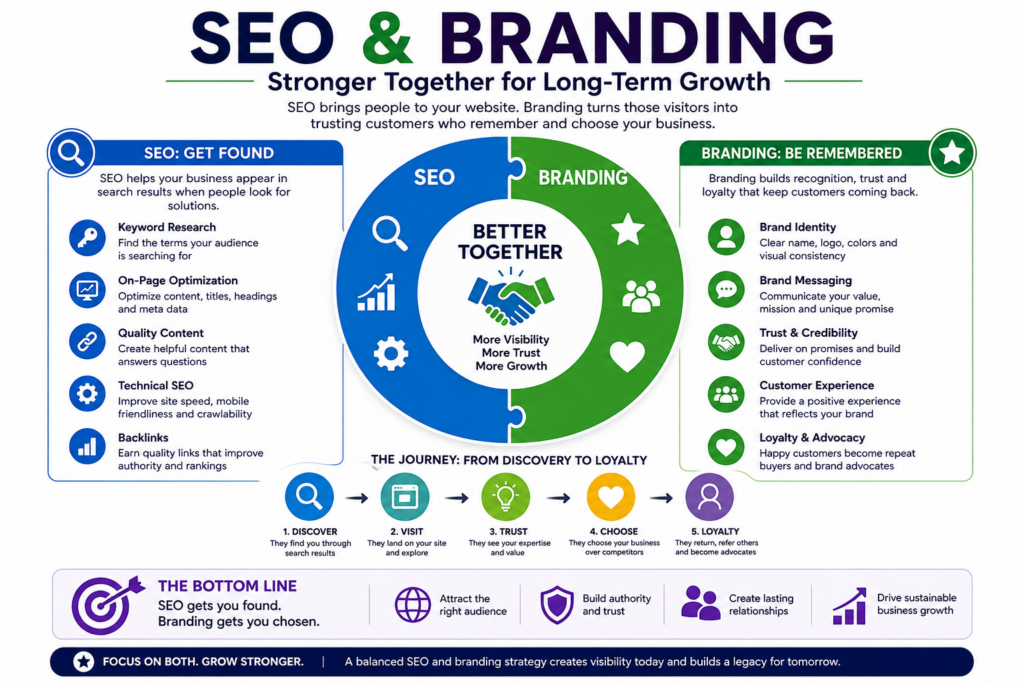
SEO helps people discover your business, while branding builds recognition, trust and long-term customer loyalty.
Older SEO advice sometimes suggested that new businesses should concentrate almost entirely on keywords and worry about branding later.
That approach is unnecessarily restrictive.
A new company certainly needs to target searches made by people who do not yet know its name. But that does not mean the company should postpone building a recognizable identity.
Consider someone searching for:
technical SEO services
They may see several companies in the search results. Ranking creates the opportunity to be seen, but the potential customer still has to decide which result looks relevant and which company appears credible.
The page title, company name, description, website appearance, content quality and overall professionalism can all influence that decision.
SEO therefore gets the business into the conversation. Branding helps the business stand out within that conversation.
Google's current guidance emphasizes helpful, reliable content created primarily for people rather than pages designed mainly to manipulate search rankings. You can read Google's official people-first content guidance.
Branded Search vs Non-Branded Search
A useful SEO strategy distinguishes between branded and non-branded searches.
What Is a Branded Search?
A branded search contains the name of a particular company, product or brand.
Examples include:
- SuperSEOPlus
- SuperSEOPlus SEO services
- SuperSEOPlus contact
- SuperSEOPlus reviews
Someone making one of these searches already knows something about the company.
What Is a Non-Branded Search?
A non-branded query describes a need, problem, product or service without naming a specific company.
Examples include:
- SEO services for small businesses
- technical SEO audit
- local SEO consultant
- how to check toxic backlinks
- content marketing services
These searches are particularly important because they provide opportunities to reach potential customers who have not encountered your brand before.
Why Both Matter
A company that ranks only for its own name may have good branded visibility but limited ability to attract new customers through organic search.
Conversely, a website that receives large amounts of non-branded traffic but has no memorable identity may struggle to turn that visibility into repeat visits, enquiries and long-term recognition.
A healthy strategy develops both.
Use Keywords Without Weakening Your Brand
Keywords remain useful because they help connect website content with the language potential customers use when searching.
The mistake is assuming that stronger optimization means repeating a keyword more often.
A page targeting SEO services does not need sentences such as:
Our SEO services provide the best SEO services for companies looking for professional SEO services.
That reads poorly and does nothing to strengthen the brand.
A better page would naturally explain specific services, problems and outcomes using relevant language such as:
- technical SEO audits;
- keyword research;
- on-page optimization;
- local search visibility;
- content strategy;
- link analysis;
- website crawling and indexing.
This creates topical relevance without making the copy sound mechanical.
A strong brand voice should remain visible throughout the page. Keywords should fit the writing rather than control it.
How to Combine SEO and Branding in Page Titles
Page titles are one of the clearest places where SEO and branding meet.
A good title should explain what the page offers while remaining concise and recognizable.
For example:
Technical SEO Services | SuperSEOPlusis clearer than:
SEO Services | Best SEO Services | Professional SEO Company | SEO ExpertsThe second version repeats similar phrases without providing additional value.
Google recommends descriptive, concise titles and specifically advises against unnecessary keyword repetition. Google also recommends keeping branding concise when a brand name is included in page titles.
Read Google's official title link recommendations.
Should Your Brand Name Be in Every Page Title?
Not necessarily.
Adding a short brand name at the end of important page titles is often reasonable:
Local SEO Services for Growing Businesses | SuperSEOPlusHowever, the page topic should normally remain immediately understandable.
The homepage is different because the company itself is usually the central subject. A homepage title might therefore place greater emphasis on the brand:
SuperSEOPlus | SEO & Digital Marketing AgencyThere is no benefit in forcing a long company slogan into every title across the website.
Content Can Build Search Visibility and Brand Authority
A well-written article can perform two jobs at once.
First, it can answer a searcher's question and attract relevant organic traffic.
Second, it can demonstrate the knowledge and perspective of the company publishing it.
This is why a business blog should not exist simply to increase the number of indexed pages.
Useful content can include:
- detailed guides;
- original observations;
- real examples;
- case studies;
- checklists;
- comparisons;
- screenshots;
- practical tutorials;
- industry commentary;
- original diagrams and infographics.
These elements provide visitors with a reason to remember where the information came from.
A generic article assembled solely around a target keyword is unlikely to create the same effect.
Update Old Content Properly
Refreshing old articles can be worthwhile, but changing a date alone does not make an article current.
A genuine update should review:
- outdated claims;
- obsolete statistics;
- broken external links;
- old screenshots;
- changed Google guidance;
- weak explanations;
- missing internal links;
- search intent.
If the original article is substantially outdated, a complete rewrite may be better than adding a few new paragraphs.
Make Your Brand Clear Across the Website
Search engines should not have to guess which name represents your business.
Your company name should be used consistently across important areas of the website, including:
- the homepage;
- logo;
- About page;
- Contact page;
- footer;
- structured data;
- social profiles;
- business listings.
Site Name in Google Search
Google can display a site name above an individual result.
Google says that site names are generated automatically from several signals, while WebSite structured data on the homepage is the primary method for indicating a preferred site name.
You can read Google's site name documentation.
For a business such as SuperSEOPlus, the site name should be represented consistently rather than appearing as several unnecessary variations.
Organization Information
Organization structured data can provide Google with additional information about the company behind a website.
Depending on the business, this can include information such as:
- organization name;
- website address;
- logo;
- contact information;
- business address;
- other company identifiers.
Structured data does not replace strong content or good SEO. Its purpose is to provide clear machine-readable information about the organization.
Internal Linking Supports SEO and Brand Navigation
Internal links help users move between relevant areas of a website and help search engines discover and understand pages.
For example, an article discussing website visibility can naturally direct readers to relevant SEO optimization services.
An article about creating useful search-focused content may also link to SEO content marketing services.
The purpose is not to place a commercial link in every paragraph. Internal links should appear where they genuinely help the reader continue their journey.
Use Descriptive Anchor Text
Instead of:
click here
use wording that gives the destination context:
Descriptive anchor text is more useful to readers and provides clearer information about the destination.
For more detail, see our guide to anchor text SEO best practices.
Backlinks, Brand Mentions and Reputation
Backlinks can help people discover a company while also helping search engines understand relationships between pages across the web.
Older link-building strategies often tried to control the anchor text of every backlink.
That is unnecessary and can become manipulative when done at scale.
Natural external links may use:
- your company name;
- your website address;
- the title of an article;
- a product or service name;
- a descriptive phrase;
- other contextual wording.
A branded backlink is therefore not a wasted link.
If an industry publication writes about SuperSEOPlus and links using the company name, that is a perfectly understandable way to reference the business.
The priority should be earning legitimate editorial references rather than forcing commercial keywords into every link.
If you are concerned about suspicious inbound links, read our guide to toxic backlinks and Google's link spam policies.
SEO and Branding for Local Businesses
The connection between branding and search visibility becomes particularly clear in local search.
A customer searching for a plumber, dentist, restaurant or marketing agency may compare several businesses before making a decision.
Accurate business information helps customers confirm that they have found the right company.
Local businesses should keep important information consistent, including:
- business name;
- address;
- telephone number;
- opening hours;
- website;
- service information.
Photographs, reviews, service descriptions and a professional website can then reinforce the identity of the business when potential customers investigate further.
SEO may create the discovery, but trust often determines which business receives the call.
How to Measure SEO and Branding Together
SEO performance should not be reduced to checking whether one keyword moved from position six to position four.
Several indicators can provide a broader view.
Non-Branded Search Queries
Look at the queries bringing visitors to your website that do not contain your company name.
These can reveal whether your content is reaching people who are discovering the business for the first time.
Branded Searches
Monitor searches containing your company name and important branded variations.
Branded search volume can be influenced by many channels, including referrals, advertising, social media, public relations and previous organic visits, so it should not automatically be attributed to SEO.
Organic Conversions
Track useful actions such as:
- contact-form submissions;
- telephone enquiries;
- quote requests;
- newsletter subscriptions;
- sales;
- other meaningful conversions.
Increasing traffic has limited value if the traffic never contributes to the business.
Search Click-Through Rate
Google Search Console can show impressions, clicks and click-through rates for queries and pages.
Titles and snippets are not branding metrics by themselves, but they affect how your pages are presented when people encounter them in search.
Common SEO and Branding Mistakes
1. Waiting to Build a Brand
A new company may not have brand recognition yet, but it still needs a clear identity from the beginning.
Customers should be able to understand who you are and what you offer when they first encounter the website.
2. Optimizing Only for the Company Name
Ranking first for a unique company name is useful, but it does not mean the website is reaching people searching for its services.
Non-branded search visibility is essential for attracting customers who do not know the business yet.
3. Keyword Stuffing
Repeating keywords unnaturally damages readability and makes marketing copy less convincing.
Use the terminology customers search for, but write for people.
4. Generic Content
Articles that merely repeat common information provide little reason for visitors to remember the company that published them.
Useful examples, clear opinions, original illustrations and practical experience make content more distinctive.
5. Inconsistent Branding
Using different company names, logos or descriptions across the website can create unnecessary confusion.
Keep important brand information consistent.
6. Over-Optimized Backlink Anchor Text
Trying to force the same commercial keyword into large numbers of backlinks can create an unnatural pattern.
Natural references often include company names, page titles and varied descriptive wording.
7. Ignoring Technical SEO
Strong branding cannot compensate for pages that search engines cannot crawl or index properly.
Technical foundations still matter.
SEO and Branding Best Practices for 2026
- Develop SEO and branding together. Do not postpone your brand identity until organic traffic arrives.
- Target genuine non-branded search demand. Reach customers who do not know your company yet.
- Protect branded search visibility. Make important company information easy to find.
- Use keywords naturally. Optimize around topics and search intent rather than repetition.
- Write concise, descriptive page titles. Add the brand name where it genuinely helps.
- Publish useful content with a recognizable point of view.
- Keep your company name and identity consistent.
- Use accurate WebSite and Organization structured data.
- Build meaningful internal links.
- Earn natural backlinks instead of manipulating anchor text.
- Measure leads and conversions alongside rankings.
- Maintain strong technical SEO.
SEO Gets You Found. Branding Helps You Get Chosen.
This is the simplest way to understand the relationship between the two disciplines.
SEO helps potential customers find your business. Branding helps them recognize it, trust it and decide whether they want to work with it.
Neither should be treated as a replacement for the other.
A beautifully branded website that nobody can discover has a visibility problem.
A highly optimized website that looks indistinguishable from every competitor has a positioning problem.
A stronger strategy combines search demand, useful content, technical quality, clear positioning and a consistent identity.
Frequently Asked Questions About SEO and Branding
Should a new company focus on SEO or branding first?
Both should begin together. New businesses need SEO to reach people who do not know the company name, but they also need a clear identity so those people understand and remember the business when they discover it.
Does branding directly improve Google rankings?
Branding should not be treated as a single direct Google ranking factor. Its value lies in building recognition, trust and consistency while supporting broader marketing activities that can contribute to search visibility.
Should I include my brand name in every SEO title?
Not necessarily. A concise brand name can be useful on many important pages, but the title should first describe the page accurately. Avoid repetitive boilerplate across the entire website.
Should I optimize my homepage for my company name?
Your homepage should clearly communicate your company identity, but it can also describe your principal services or market. There is usually no reason to repeat the brand name unnaturally throughout the page.
Are branded backlinks useful for SEO?
Yes. A backlink using a company name can be a natural editorial reference. Not every backlink needs to use an exact-match commercial keyword.
What is the difference between branded and non-branded keywords?
Branded keywords contain your company or product name. Non-branded keywords describe products, services, topics or problems without identifying a particular company.
How can content strengthen a brand?
Content can demonstrate expertise, answer customer questions, explain the company's approach and provide original resources that people associate with the business.
Final Thoughts
The old idea that businesses should choose between SEO and branding is no longer useful.
SEO should not strip personality from a website, and branding should not prevent a business from targeting the searches potential customers actually make.
The objective is to be discoverable without becoming generic.
Build pages around genuine customer needs. Use keywords naturally. Publish content worth reading. Keep your brand identity consistent. Strengthen internal linking and technical SEO. Earn relevant references rather than manipulating backlinks.
When these elements work together, organic search does more than generate visits. It introduces new customers to a business they can recognize, understand and remember.
Want to strengthen both your search visibility and your digital presence? SuperSEOPlus can review your website, content and technical SEO to identify practical opportunities for sustainable organic growth.
About us and this blog
We are a digital marketing company with a focus on helping our customers achieve great results across several key areas.
Request a free quote
We offer professional SEO services that help websites increase their organic search score drastically in order to compete for the highest rankings even when it comes to highly competitive keywords.
More from our blog
See all posts
Recent Posts
- How to Rank Higher on Google Maps: What to Fix First October 22, 2026
- Can You Do Local SEO Without a Website? What Works and What Doesn't October 22, 2026
- Service-Area Business on Google Maps: How to Set It Up Properly October 20, 2026