Anchor text SEO still matters in 2026, but not in the simplistic way many older SEO guides describe it. Search engines use links to discover pages and understand relationships between content, while the visible words inside a link help users and Google understand what the linked page is about.
The goal is not to force exact-match keywords into every link. In fact, overly optimized anchor text can look unnatural and may become part of a manipulative linking pattern.
This guide explains how anchor text works, the main anchor text types, how Google evaluates anchor text, how to optimize internal and external links safely, and which anchor-text practices should be avoided.
What Is Anchor Text?
Anchor text is the visible, clickable text inside a hyperlink.
For example:
<a href="https://example.com/seo-audit/">technical SEO audit</a>In this example, technical SEO audit is the anchor text.
Anchor text gives readers context about what they can expect after clicking a link. It can also help search engines understand the relationship between the linking page and the destination page.
Google's current link guidance states that good anchor text should be descriptive, reasonably concise and relevant to both the page containing the link and the page being linked to.
You can read Google's official link and anchor text best practices.
Why Anchor Text Matters for SEO
Links perform several important functions on a website.
- They help users navigate between related pages.
- They help search engines discover new URLs.
- They provide contextual information about linked content.
- They help establish relationships between topics across a website.
- External backlinks can act as signals of relevance and authority.
Anchor text contributes to that context.
For example, a link saying technical SEO checklist gives both users and search engines considerably more information than a generic link saying click here.
That does not mean every link should contain an exact target keyword. Natural language and usefulness to the reader should come first.
Common Types of Anchor Text
A natural link profile usually contains several different types of anchor text.
Exact-Match Anchor Text
Exact-match anchor text uses the exact keyword targeted by the destination page.
Example:
anchor text SEO
Exact-match anchor text can be highly descriptive, but repeatedly creating external backlinks with exactly the same commercial keyword may look manipulative.
Partial-Match Anchor Text
Partial-match anchor text contains the main topic together with additional words.
Example:
anchor text SEO best practices
This often reads more naturally than forcing the exact same keyword into every link.
Branded Anchor Text
Branded anchor text uses a company or website name.
Examples include:
- SuperSEOPlus
- Google Search Central
- Ahrefs
- Semrush
Branded links are completely normal and often make sense when referring to a company, product, publication or source.
Naked URL Anchor Text
A naked URL displays the destination address itself:
https://example.com/seo-guide/
These links occur naturally, especially in references and citations.
Generic Anchor Text
Generic anchors include phrases such as:
- click here
- learn more
- read this
- visit the website
These are not automatically harmful, but descriptive anchor text usually provides more context for users and search engines.
Image Anchor Text
When an image is used as a link, Google can use the image's alt attribute as anchor text.
That makes descriptive image alt text important when an image links to another page.
What Does Google Say About Anchor Text in 2026?
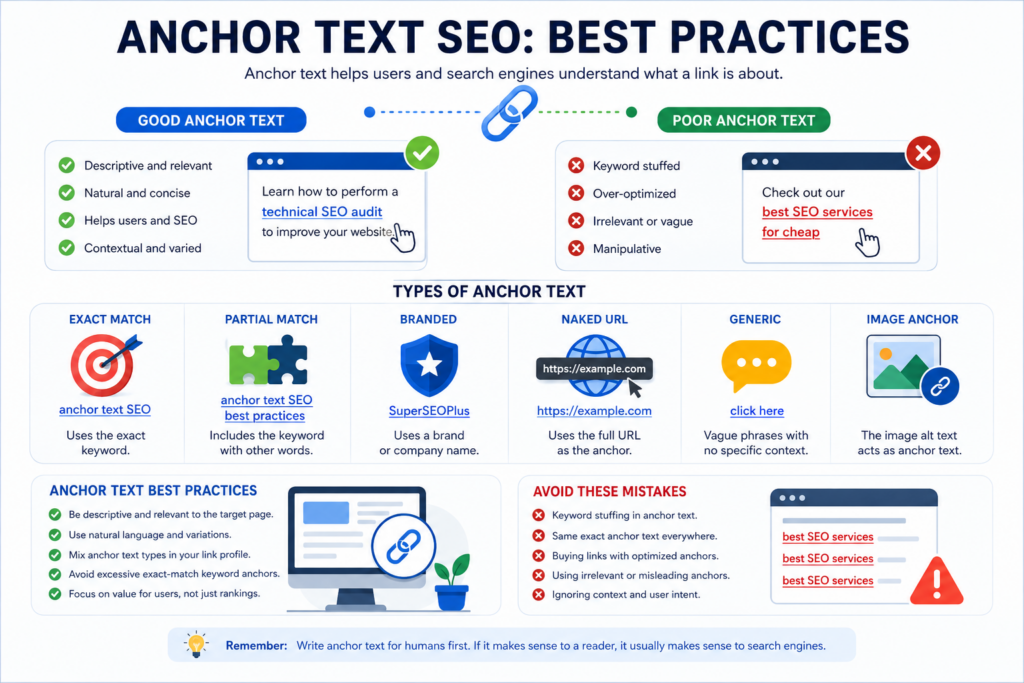
Anchor text SEO best practices, including descriptive links, anchor types and common over-optimization mistakes.
Google recommends writing anchor text that is:
- descriptive;
- reasonably concise;
- relevant to the linked page;
- useful to readers;
- written naturally.
Google specifically advises site owners to resist the temptation to cram every related keyword into anchor text.
The words surrounding a link also matter because they provide additional context.
For example, this:
Learn how to perform a technical SEO audit before launching a new website.
is clearer than:
click here
The first example explains what users will find when they follow the link.
How to Optimize Anchor Text for Internal Links
Internal linking is one of the areas where website owners have the greatest control over anchor text.
Every important page on your website should ideally be reachable from at least one other relevant page.
When creating an internal link, choose anchor text that describes the destination naturally.
For example:
Better:
Learn how Google discovers and indexes website pages.
Less helpful:
To learn more, click here.
The first version gives both the reader and search engine useful context.
Avoid Repeating the Same Anchor Everywhere
You do not need to link to the same page using exactly the same keyword every time.
Natural variations are often more readable.
For a page about backlink analysis, appropriate internal anchors could include:
- backlink audit
- analyze your backlinks
- checking your backlink profile
- toxic backlinks guide
The anchor should fit naturally within the surrounding sentence.
Anchor Text for External Backlinks
External backlinks are different because website owners normally do not control how other sites describe them.
If a journalist links to your company name, that branded anchor may be completely appropriate.
If another website references the title of one of your articles, that may also be natural.
The old SEO practice of trying to make every external website link using the exact commercial keyword is not a strategy we recommend.
A backlink profile containing brand names, URLs, article titles, natural phrases and topical descriptions is generally more realistic than one dominated by a single exact-match keyword.
Can Over-Optimized Anchor Text Hurt SEO?
Potentially, yes.
Google's spam policies identify several practices involving optimized anchor text as examples of link spam when they are used primarily to manipulate rankings.
Examples can include:
- keyword-rich links in large-scale guest-post campaigns;
- optimized links in distributed press releases;
- keyword-rich forum signatures or comments;
- links embedded in widely distributed widgets;
- sitewide template or footer links created primarily for ranking purposes;
- paid links that pass ranking credit.
Google's full guidance is available in its official Search spam policies.
The lesson is not that keyword-rich anchor text is automatically bad. The problem is manipulating links at scale primarily to influence search rankings.
Anchor Text and Image Links
Images can also function as links.
When that happens, Google's documentation explains that the image's alternative text can be used as anchor text.
For example:
<a href="/seo-audit/">
<img src="seo-audit-report.webp" alt="technical SEO audit report">
</a>
The alt attribute should describe the image meaningfully rather than being stuffed with keywords.
Good alt text also improves accessibility for users who rely on screen readers.
Anchor Text for Paid and Sponsored Links
Paid advertising and sponsorships are legitimate parts of online marketing, but paid links should not be disguised as editorial ranking signals.
Google recommends qualifying advertising or paid placements using:
rel="sponsored"
For example:
<a href="https://example.com/" rel="sponsored">Marketing Partner</a>rel="nofollow" can also be used in appropriate situations, although Google says sponsored is preferred for paid placements.
For user-generated links such as comments or forum posts, rel="ugc" may be appropriate.
You can review Google's official outbound link qualification guidance.
Anchor Text SEO Best Practices for 2026
A strong anchor-text strategy is simpler than many SEO guides make it sound.
- Describe the destination. Give readers a clear idea of what they will find.
- Keep anchor text concise. Avoid unnecessarily long linked sentences.
- Write naturally. Do not force keywords into a sentence simply for SEO.
- Use contextual links. Place links where they genuinely help the reader.
- Avoid excessive exact-match backlink campaigns.
- Use descriptive internal links. They help users and search engines understand your site's structure.
- Do not buy keyword-rich links for ranking manipulation.
- Use sponsored or UGC attributes where appropriate.
- Optimize image alt text when images act as links.
- Think about the reader first.
Anchor Text and Toxic Backlinks
Anchor text can also provide clues when evaluating suspicious backlink patterns.
For example, if hundreds of unrelated websites suddenly link to the same page using identical commercial keywords, that may deserve investigation.
However, anchor text alone does not prove that a backlink is harmful.
You should evaluate the context, origin, relevance and method by which the links were acquired.
For a deeper explanation, read our guide to toxic backlinks and Google's link spam policies.
Frequently Asked Questions About Anchor Text SEO
Does anchor text still matter for SEO?
Yes. Google says anchor text helps users and Google understand the page being linked to. However, it should be descriptive and natural rather than stuffed with keywords.
What is the best anchor text for SEO?
There is no single ideal anchor text. The best choice is usually concise wording that accurately describes the linked page and makes sense within the surrounding content.
Should every backlink use my target keyword?
No. Trying to force exact-match keywords into every backlink can create an unnatural linking pattern. Branded anchors, URLs, page titles and contextual phrases can all occur naturally.
Is “click here” bad for SEO?
Not necessarily, but descriptive anchor text is usually more useful because it gives users and search engines better context.
Can anchor text cause a Google penalty?
Anchor text itself is not inherently dangerous. Problems can arise when optimized links are created at scale primarily to manipulate rankings, especially through paid links, link schemes, distributed content, comments or automated link building.
Final Thoughts
Anchor text SEO in 2026 is about relevance and context—not keyword repetition.
The strongest anchor text helps users understand where a link leads while giving search engines useful contextual information about the destination.
For internal links, use clear and descriptive wording. For backlinks, focus on earning genuine editorial references rather than trying to control every anchor. For paid, sponsored or user-generated links, use the appropriate link attributes.
A natural linking structure benefits users first and gives search engines clearer signals about how your content fits together.
Need help improving your site's internal linking, backlink profile or technical SEO? SuperSEOPlus can identify opportunities and build a more sustainable search strategy.
About us and this blog
We are a digital marketing company with a focus on helping our customers achieve great results across several key areas.
Request a free quote
We offer professional SEO services that help websites increase their organic search score drastically in order to compete for the highest rankings even when it comes to highly competitive keywords.
More from our blog
See all posts
Recent Posts
- How to Rank Higher on Google Maps: What to Fix First October 22, 2026
- Can You Do Local SEO Without a Website? What Works and What Doesn't October 22, 2026
- Service-Area Business on Google Maps: How to Set It Up Properly October 20, 2026