Can toxic backlinks hurt your Google rankings in 2026? The answer is more nuanced than a simple yes or no. Google has become increasingly effective at identifying link spam and deciding which backlinks deserve to influence search rankings. In many cases, suspicious links may simply provide little or no ranking value. However, backlinks created through manipulative link schemes can still create serious SEO problems, especially when a website has deliberately participated in practices that violate Google's spam policies.
If you discover strange domains linking to your website, that does not automatically mean you have been hit by negative SEO or that you should immediately disavow every suspicious backlink.
This guide explains what toxic backlinks really are, which backlinks Google considers problematic, whether competitors can damage your rankings with bad links, how to audit your backlink profile, and when Google's Disavow Tool should actually be used.
What Are Toxic Backlinks?
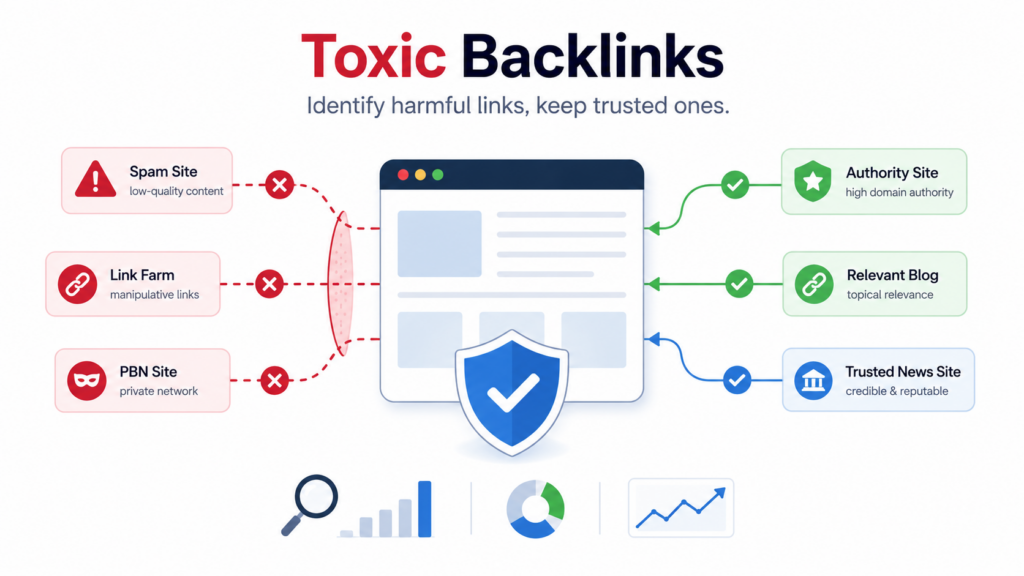
Examples of potentially toxic backlinks compared with relevant, authoritative backlinks.
The phrase toxic backlinks is commonly used in the SEO industry to describe inbound links that appear spammy, manipulative, artificial or extremely low quality.
Google does not normally classify links using the label “toxic.” Its documentation instead refers to concepts such as link spam, unnatural links, artificial links and low-quality links.
This distinction matters because a backlink being low quality does not automatically mean that your website will receive a penalty.
A random link from an obscure website, scraper, abandoned blog or spam page can appear in almost any backlink profile. The web is messy, and legitimate websites naturally accumulate links that they never requested.
The greater concern is a pattern of backlinks deliberately created to manipulate search rankings.
Can Toxic Backlinks Hurt Your SEO in 2026?
Potentially, yes—but context matters.
Google states that it works hard to prevent actions on third-party websites from negatively affecting another website. That means discovering a few suspicious backlinks should not cause immediate panic.
At the same time, Google acknowledges that incoming links can affect how it evaluates a website in certain circumstances. This is particularly relevant when a site owner, employee, SEO agency or link-building provider has intentionally created paid, artificial or manipulative links. Building quality Backlinks
The key distinction is therefore between links that happen to point at your site and links deliberately created as part of a ranking manipulation strategy.
If hundreds of strange websites suddenly link to your site without your involvement, that is very different from purchasing hundreds of keyword-rich backlinks specifically to manipulate Google rankings.
What Does Google Consider Link Spam?
Google defines link spam as creating links to or from a website primarily for the purpose of manipulating search rankings.
According to Google's current spam policies, problematic practices can include:
- Buying or selling links intended to influence rankings.
- Exchanging products or services in return for ranking links.
- Excessive reciprocal linking arrangements.
- Using automated software or services to generate backlinks.
- Large-scale low-quality directory or bookmark links.
- Keyword-rich links embedded in widely distributed widgets.
- Sitewide links inserted into templates or footers primarily for SEO.
- Keyword-optimized links placed in forum comments or signatures.
- Advertorial or sponsored content containing unqualified links designed to pass ranking signals.
- Creating low-value content primarily to generate links and manipulate ranking signals.
You can review the full policy directly in Google's official Google Search spam policies.
Notice that the problem is not simply that a backlink comes from a small or unfamiliar website. Intent, scale, patterns and manipulation are far more important.
Are Paid Links Always Against Google's Rules?
No. Advertising, sponsorships and commercial relationships are normal parts of the web.
The SEO problem occurs when a paid link is intended to pass ranking credit.
Google recommends qualifying sponsored links appropriately, typically using the rel="sponsored" attribute. A rel="nofollow" attribute may also be appropriate in certain situations.
For example:
<a href="https://example.com/" rel="sponsored">Sponsored Partner</a>This allows businesses to advertise and collaborate without disguising paid links as editorial recommendations intended to manipulate rankings.
Can Competitors Hurt Your Rankings With Toxic Backlinks?
This concern is commonly referred to as negative SEO: a competitor or malicious third party creates spammy backlinks to another website in an attempt to damage its search performance.
Google explicitly states that it works to prevent other website owners from being able to harm your rankings simply by linking to your site.
Therefore, finding spam backlinks does not automatically mean that a competitor can easily destroy your rankings.
However, Google's wording is important. It does not say that incoming links can never affect a website. Google's own Disavow Tool documentation acknowledges that incoming links can affect Google's assessment in certain circumstances.
The practical conclusion is simple:
Do not panic about ordinary backlink spam, but do take deliberately manipulated backlink campaigns seriously.
How to Identify Potentially Toxic Backlinks
Evaluating backlinks requires more than looking at a third-party SEO tool's “toxicity score.” No third-party metric is a Google penalty score.
Instead, look for patterns and context.
1. Check Google Search Console
Start with your own data.
Google Search Console provides information about websites and pages linking to your domain. You can review this under the Links section of Search Console.
Pay particular attention to unexpected spikes, domains you recognize from previous link-building campaigns, and large groups of links using highly optimized anchor text.
2. Investigate Suspicious Domains
A suspicious-looking domain is not automatically harmful. Review the actual page linking to you.
Ask whether the link appears editorially relevant or whether the page seems to exist mainly for linking purposes.
A legitimate industry blog linking naturally to one of your guides is completely different from a network containing thousands of unrelated pages filled with keyword-rich links.
3. Examine Anchor Text Patterns
Natural backlink profiles usually contain a mixture of brand names, URLs, article titles, generic phrases and descriptive anchor text.
A highly artificial profile may contain an unusually large concentration of commercial exact-match keywords.
For example, a London SEO agency receiving hundreds of newly created links with exactly the same phrase such as “best SEO agency London” deserves closer inspection.
4. Look at How the Links Were Acquired
This is often more revealing than any SEO metric.
Ask whether you—or someone working for your business—previously purchased links, hired an aggressive link-building service, participated in private link networks, used automated backlink software or arranged large-scale exchanges.
If the answer is yes, there may be a genuine link-spam issue rather than harmless background noise.
What Should You Do About Toxic Backlinks?
The correct response depends on how the links were created.
If you had no involvement with them and there is no manual action or evidence of a deliberate manipulative campaign, you should not automatically start submitting large disavow files.
If you or a previous SEO provider intentionally created artificial links, the situation deserves closer attention.
First: Stop Creating Manipulative Links
If questionable link building is still happening, stop it.
Continuing to buy links while trying to clean older links is not a sustainable SEO strategy.
Second: Try to Remove Links You Created
If you control the links or can contact the websites responsible for them, request removal where appropriate.
Google specifically recommends making an effort to remove spammy or low-quality links before relying on disavowal when dealing with unnatural-link manual actions.
Third: Check Search Console for Manual Actions
Open Google Search Console and check:
Security & Manual Actions → Manual Actions
If Google has applied an unnatural-links manual action, Search Console should provide information about the issue.
Google's official documentation explains that a pattern of unnatural, artificial, deceptive or manipulative backlinks can result in a manual action affecting some or all of a website.
Read Google's official Manual Actions documentation for additional guidance.
When Should You Use Google's Disavow Tool?
This is where many website owners make a serious mistake.
Google says most websites do not need to use the Disavow Tool.
Google recommends considering disavowal only when both of these conditions are present:
- You have a considerable number of spammy, artificial or low-quality links pointing to your site.
- Those links have caused a manual action or are likely to cause one.
The Disavow Tool is an advanced feature. Google warns that using it incorrectly can potentially damage your website's performance in Google Search.
Therefore, you should not download every backlink identified as “toxic” by an SEO platform and automatically upload the domains to Google.
Read Google's official Disavow Links documentation before taking any action.
Do SEO Toxicity Scores Mean Google Has Penalized You?
No.
SEO platforms can provide useful backlink analysis, but metrics such as toxicity scores, spam scores, domain authority and similar proprietary ratings are created by those companies.
They are not Google Search Console penalties and should not be treated as proof that Google considers a particular backlink harmful.
Use third-party tools for investigation—not as an automatic instruction to delete or disavow links.
How to Build Backlinks Safely in 2026
The safest long-term backlink strategy is to give other websites legitimate reasons to reference your content.
That can include publishing original research, useful industry guides, statistics, case studies, tools, templates, expert commentary and resources that genuinely help readers.
Digital PR, relevant industry partnerships and editorial outreach can also generate valuable links when the resulting recommendations are genuine rather than purchased ranking signals.
Instead of asking, “How many backlinks can I build this month?” ask:
“What can we publish that reputable websites would genuinely want to reference?”
That shift produces links that are much more aligned with sustainable SEO.
Toxic Backlinks vs Low-Quality Backlinks
It is also important not to confuse low-quality backlinks with deliberate link spam.
A link may come from a weak website and provide little SEO benefit without creating a penalty.
Websites naturally acquire strange links over time through crawlers, scraper sites, aggregators, copied content, abandoned domains and other sources outside the website owner's control.
The presence of these links alone does not justify aggressive backlink removal.
Focus instead on patterns of manipulation, especially links intentionally created to influence search rankings.
Should You Regularly Audit Your Backlinks?
Yes, especially if SEO is an important acquisition channel for your business.
A periodic backlink audit can help identify unexpected link-building activity, compromised SEO campaigns, suspicious anchor-text patterns and potentially valuable backlinks worth protecting.
However, backlink monitoring should be part of a larger SEO strategy rather than an obsession with removing every weak domain.
Technical SEO, useful content, internal linking, crawlability, site performance and search intent usually deserve at least as much attention.
If you're also improving how Google discovers and indexes your pages, read our guide to search engine submission and Google indexing.
Frequently Asked Questions About Toxic Backlinks
What is a toxic backlink?
A toxic backlink is an SEO-industry term for an inbound link believed to be spammy, artificial, manipulative or potentially harmful. Google itself more commonly refers to link spam, unnatural links, artificial links and low-quality links.
Can one bad backlink hurt my rankings?
Usually, discovering a single suspicious backlink is not a reason to panic. Google works to prevent third-party actions from harming legitimate websites. Larger patterns of deliberately manipulative link building are much more concerning than isolated unwanted links.
Should I disavow every spam backlink?
No. Google explicitly says that most websites do not need the Disavow Tool. It should be used cautiously and primarily when there is a considerable volume of artificial or spammy links combined with a manual action or a strong likelihood of one.
Can competitors create toxic backlinks to hurt my site?
Competitors can technically create links pointing to another website, but Google says it works hard to prevent third parties from negatively affecting a site's rankings. This is why random suspicious backlinks should not automatically trigger a disavow campaign.
Are paid backlinks against Google's policies?
Paid links intended to manipulate rankings violate Google's link-spam policies. Paid advertising or sponsorship itself is acceptable when the link is appropriately qualified, such as with rel="sponsored" or, where appropriate, rel="nofollow".
How can I check my backlinks?
Google Search Console provides a Links report showing linking websites, linking pages and anchor information. Professional SEO platforms can provide additional analysis, but their proprietary spam or toxicity metrics should not be confused with Google's own assessment.
Final Thoughts: Don't Panic Over Every Toxic Backlink
The old SEO belief that “inbound links can never hurt your rankings” is too simplistic for modern search.
At the same time, the opposite belief—that every suspicious backlink is dangerous—is also wrong.
Google's current guidance points toward a much more practical approach: avoid manipulative link schemes, monitor your backlink profile, investigate genuine signs of unnatural link building and reserve the Disavow Tool for situations where it is actually warranted.
For most website owners, the better investment is not spending hours trying to eliminate every questionable backlink. It is building a technically sound website, publishing genuinely useful content and earning relevant editorial links over time.
Concerned about your backlink profile or organic visibility? SuperSEOPlus can review your technical SEO, backlink profile and search performance to identify the issues that actually deserve attention.
SuperSEOPlus Editorial is the editorial byline for articles published on SuperSEOPlus. It is a publication byline, not an individual author. The guides cover SEO, local SEO, link building, content marketing, WordPress and digital marketing, and aim to explain how these topics work in practical terms. Where an article recommends third-party tools or products, any affiliate relationship is disclosed in the article. We do not guarantee rankings, traffic or income.
About us and this blog
We are a digital marketing company with a focus on helping our customers achieve great results across several key areas.
Request a free quote
We offer professional SEO services that help websites increase their organic search score drastically in order to compete for the highest rankings even when it comes to highly competitive keywords.
More from our blog
See all posts
Recent Posts
- Local SEO for Electricians: How to Win More Local Jobs October 24, 2026
- How to Build Backlinks: 12 Manual Methods That Work October 24, 2026
- Dofollow Backlinks: What They Are and When They Matter October 24, 2026