Reciprocal links have been part of link building for almost as long as websites have competed for visibility in search results. The idea is simple: one website links to another, and the second website links back.
But are reciprocal links bad for SEO?
Not necessarily. A natural reciprocal link is very different from a large-scale link exchange created primarily to manipulate search rankings. Understanding that distinction is important when building backlinks today.
Google's spam policies specifically identify excessive link exchanges and partner pages created exclusively for cross-linking as examples of link spam. That does not mean every situation where two websites link to each other is automatically a violation.
What Are Reciprocal Links?
A reciprocal link occurs when two websites link to each other.
For example, Website A links to Website B, while Website B also contains a link back to Website A.
This can happen naturally. Two companies may work together, a supplier may reference a distributor, an industry association may list a member, or two publishers may independently reference useful resources from each other's websites.
Reciprocity alone does not tell you whether a link is useful, manipulative or problematic.
The purpose of the links, their relevance and the broader linking pattern matter much more.
Are Reciprocal Links Bad for SEO?
The statement that Google automatically ignores or penalizes every reciprocal link is too simplistic.
Google's current spam policies focus instead on links created primarily to manipulate search rankings. One example specifically mentioned by Google is excessive link exchanges, such as arrangements based on the principle of "link to me and I'll link to you."
The important word is excessive.
If two legitimate websites have a genuine reason to reference each other, the existence of links in both directions does not by itself make the relationship spam.
The situation becomes much more questionable when reciprocal linking turns into a deliberate backlink-production system.
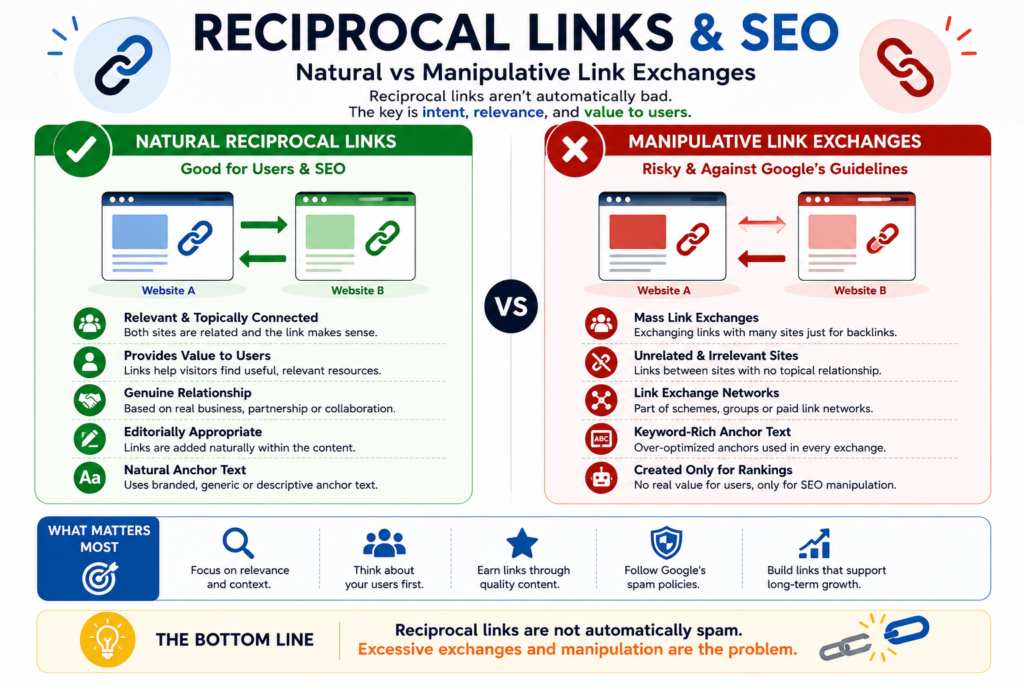
Natural reciprocal links can provide value to users, while excessive link exchanges created primarily to manipulate rankings can violate Google’s spam policies.
When Reciprocal Links Are Natural
There are many situations in which reciprocal links can occur naturally on the web.
Imagine a web design company that creates a website for a professional photographer. The designer publishes a case study showing the finished project and links to the photographer's website. The photographer later adds a page explaining who designed the website and links back to the agency.
Both links have a legitimate reason to exist.
Other examples can include business partnerships, professional associations, interviews, research citations, complementary resources and organizations working together on a project.
A useful question is:
Would these links still make sense if search engines did not exist?
If the answer is yes, there is usually a genuine editorial or user-focused reason behind the links.
When Link Exchanges Become a Problem
Reciprocal linking becomes risky when obtaining ranking signals becomes the primary reason for creating the links.
Patterns that deserve particular caution include:
- Exchanging links with large numbers of unrelated websites.
- Creating partner pages exclusively for exchanging backlinks.
- Sending mass emails offering a backlink in return for another backlink.
- Joining networks whose primary purpose is exchanging links.
- Repeatedly using keyword-rich anchor text in exchanged links.
- Creating links that provide little or no value to visitors.
- Automating link exchanges across many websites.
Google describes links created primarily to manipulate search rankings as link spam. Its current spam policies explicitly include excessive link exchanges among the examples.
That is very different from saying that every reciprocal link is harmful.
What About Three-Way Link Exchanges?
Some link builders attempt to make exchanges less obvious by introducing additional websites.
Instead of Website A linking directly to Website B and Website B linking back, the arrangement might look like this:
Website A → Website B → Website C → Website A
Another variation involves one company controlling several websites and using them to fulfil link-exchange agreements indirectly.
Changing the structure does not change the underlying purpose.
If links are being created primarily to manipulate ranking signals, adding another website to the chain does not transform the arrangement into a legitimate editorial recommendation.
Rather than asking whether a particular exchange pattern can be detected, website owners should ask whether the links genuinely help users and make editorial sense.
Relevance and Quality Matter More Than Simple Reciprocity
A backlink should make sense within the context of the page where it appears.
If an SEO agency publishes an article about technical website performance and references a respected performance-testing resource, that link has a clear contextual purpose.
If the same article suddenly links to an unrelated casino, clothing shop or property website simply because those websites agreed to provide backlinks in return, the links have little editorial justification.
This is why backlink strategies should not be reduced to collecting the largest possible number of links.
Relevance, editorial context, website quality and the reason a link exists are much more useful considerations.
Avoid Manipulative Anchor Text
Anchor text is another important consideration when evaluating reciprocal links.
Suppose two websites agree to exchange links and both insist on exact-match commercial phrases as their anchor text. Repeating this process across many websites can create an obviously manufactured linking pattern.
Anchor text should describe the destination naturally rather than being forced into every link for ranking purposes.
We explain this subject in more detail in our guide to anchor text and backlinks.
Natural backlink profiles typically contain a mixture of branded names, page titles, descriptive phrases, URLs and other contextually appropriate anchors.
Better Ways to Earn Backlinks
Instead of building an SEO strategy around reciprocal exchanges, invest in creating pages that other websites have a genuine reason to reference.
Useful link-worthy assets can include:
- Original research and statistics.
- Detailed tutorials.
- Industry guides.
- Case studies with real results.
- Useful tools and calculators.
- Original diagrams and visual resources.
- Expert commentary.
- Frequently updated reference resources.
Promotion still matters. Publishing excellent content does not guarantee that other website owners will discover it automatically.
You can introduce useful resources to journalists, publishers, businesses and industry organizations when there is a genuine reason they may find the resource valuable.
The difference is that you are promoting something worth referencing rather than offering a backlink as payment for another backlink.
Should You Remove Existing Reciprocal Links?
Do not start deleting legitimate links simply because another website happens to link back to you.
Review the purpose and context of the relationship instead.
For each questionable reciprocal link, consider:
- Is the other website relevant to the subject?
- Does the link genuinely help visitors?
- Would you keep the link if it provided no SEO benefit?
- Was the link editorially chosen or created only as part of an exchange?
- Is this an isolated relationship or part of a large systematic exchange campaign?
- Does the anchor text look natural?
A few legitimate reciprocal relationships are very different from hundreds of manufactured exchanges.
If you are reviewing a broader backlink profile, our guide to toxic backlinks and harmful links explains how to evaluate questionable inbound links without assuming that every unusual backlink is dangerous.
Reciprocal Linking Best Practices for 2026
A sensible approach to reciprocal links can be summarized with a few principles:
- Link for users first. The destination should genuinely add value to the page.
- Prioritize relevance. Links should make sense within the subject and context.
- Avoid large-scale exchanges. Do not make reciprocal linking the foundation of your backlink strategy.
- Keep anchor text natural. Do not force commercial keywords into exchanged links.
- Avoid dedicated exchange networks. Links created systematically for ranking manipulation can fall within Google's link spam policies.
- Earn editorial links. Create resources that publishers want to reference independently.
- Evaluate patterns rather than isolated links. A legitimate reciprocal relationship should not be treated the same way as systematic cross-linking.
Google's spam policies for Google Web Search provide the current definitions and examples of link spam.
Reciprocal Links Are Not Automatically Bad — Manipulative Link Exchanges Are
The old idea that Google simply discounts every reciprocal link should be retired.
Reciprocal links are a normal part of the web and can appear naturally whenever websites, businesses and publishers have genuine relationships or useful resources to reference.
The SEO problem begins when link exchanges become systematic and their primary purpose is manipulating rankings.
Instead of worrying about whether every website linking to you also receives a link from you, focus on a more useful question: Does this link deserve to exist for the people using the page?
If the answer is yes, you are approaching linking from a much stronger foundation.
Frequently Asked Questions About Reciprocal Links
Does Google penalize all reciprocal links?
No. Google's spam policies specifically identify excessive link exchanges and partner pages created exclusively for cross-linking as examples of link spam. This is not the same as saying that every pair of websites linking to each other is automatically a violation.
Can reciprocal links help SEO?
A relevant editorial link can help users discover useful information and can contribute to how pages are discovered and understood. However, reciprocal links should not be created primarily to manipulate rankings, and there is no guaranteed ranking benefit from exchanging links.
How many reciprocal links are safe?
There is no useful universal number or percentage to target. Evaluate why each link exists instead of trying to stay below an arbitrary threshold.
Are three-way link exchanges safer?
Adding another website to an exchange does not make a manipulative arrangement legitimate. The underlying purpose of the links remains the important consideration.
Should I accept requests to exchange backlinks?
Only link when the destination genuinely deserves to be referenced and provides value to your audience. Avoid agreements where the principal reason for linking is simply receiving another backlink.
Should I remove every reciprocal backlink from my website?
No. Legitimate partnerships, citations and editorial references can naturally produce links in both directions. Concentrate on identifying systematic or manipulative link-building patterns rather than deleting useful links merely because they happen to be reciprocal.
About us and this blog
We are a digital marketing company with a focus on helping our customers achieve great results across several key areas.
Request a free quote
We offer professional SEO services that help websites increase their organic search score drastically in order to compete for the highest rankings even when it comes to highly competitive keywords.
More from our blog
See all posts





Recent Posts
- WordPress Website Design: 10 Powerful Tips & Complete Guide September 20, 2026
- Local Citation Building Services: Costs, Benefits & How to Choose September 18, 2026
- Toxic Backlinks: Can Bad Links Hurt SEO in 2026? August 31, 2026