Local SEO for dentists is the work of helping your practice appear when people nearby search for a dentist, and giving them reason to trust you once they find you. Unlike most trades, dental practices work under professional regulation, handle sensitive patient information and can have several clinicians under one roof, all of which shape how you should approach reviews, profiles and content.
Patients search for dental care in different ways: "emergency dentist near me" when in pain, "teeth whitening [town]" or "Invisalign cost" when researching, and "NHS dentist" or "dentist accepting new patients" in the UK. This guide covers the essentials for UK and US practices, with the compliance points that matter. It is general information, so check current rules with your regulator or professional body. For Google's own explanation, see its tips to improve your local ranking.
Table of Contents
Why local SEO for dentists is different
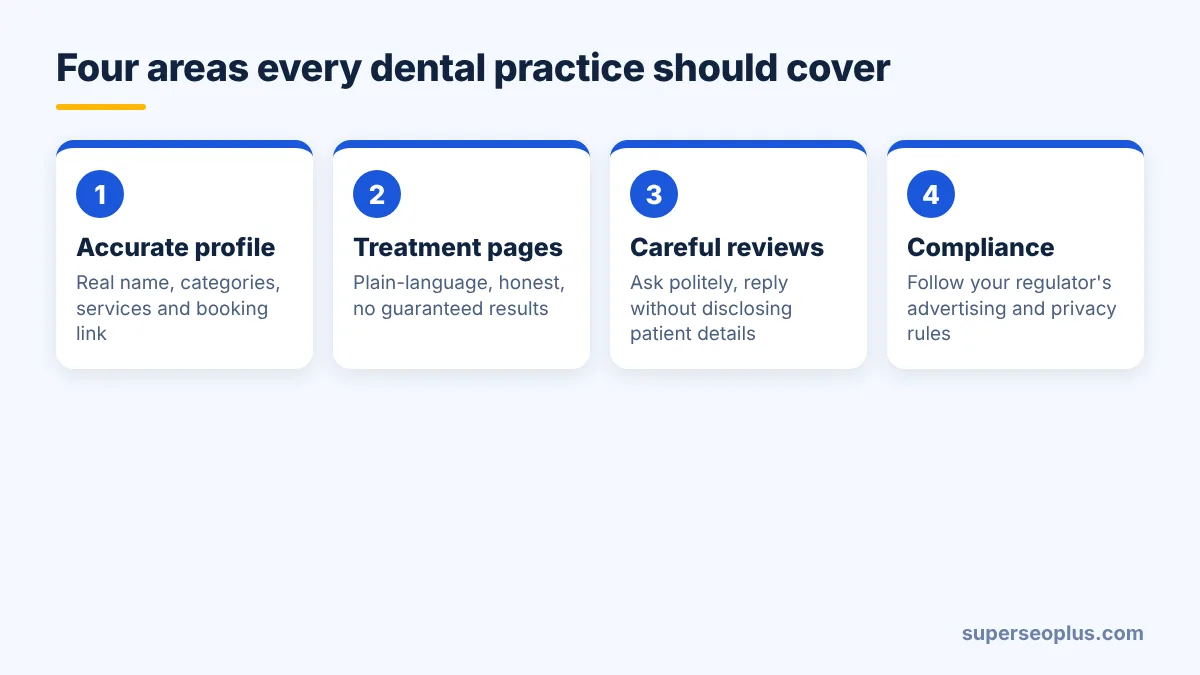
- Regulation. In the UK, the General Dental Council sets standards for how dental professionals advertise and behave, and the Advertising Standards Authority also applies. In the US, state dental boards and advertising rules apply. Your marketing must be truthful and not misleading.
- Privacy. Replying to patient reviews needs care. Do not confirm someone is a patient or discuss treatment in public replies.
- Multiple practitioners. Individual dentists may have their own profiles, which brings extra guidelines.
- Different intents. Emergency, routine, cosmetic and referral searches all need different pages.
Step 1: Business Profile set-up for practices
- Primary category: "Dentist" for most practices. Add accurate secondary categories such as "Cosmetic dentist" or "Orthodontist" only where they apply.
- Name: use your real practice name. Do not add keywords such as "Best Dentist Manchester".
- Services: list treatments you really offer: check-ups, hygiene, fillings, emergency appointments, implants, whitening, and so on.
- Accepting new patients and NHS or insurance details: keep these current, as outdated information frustrates patients and leads to bad reviews.
- Photos: reception, surgeries, the team and exterior. Be mindful of patient privacy and consent.
- Booking link: add one if you offer online booking.
Our Business Profile optimisation checklist covers each field in detail.
Step 2: Treatment pages with real substance
Build a separate page for each major treatment. Good dental pages:
- Explain what the treatment is, who it suits, and what to expect, in plain language.
- Discuss typical stages and recovery honestly, without exaggerating results.
- Give price guidance or the factors that affect cost, and finance options where available.
- Show who will carry out the treatment, with their qualifications and registration details.
- Include an easy way to book or call, and clear emergency instructions.
Avoid guaranteeing outcomes, and avoid before-and-after claims you cannot substantiate. Review current advertising guidance for your regulator.
Step 3: Reviews, handled carefully
Reviews help patients choose and form part of Google's prominence signals. Ask patients in a way that follows guidelines: a polite request with a direct link, no incentives and no filtering to only happy patients. When replying:
- Thank people without confirming treatment or patient status.
- For criticism, invite the person to contact the practice and avoid debating specifics publicly.
- Follow your data protection obligations. In the UK that means UK GDPR guidance from the Information Commissioner's Office. In the US, health privacy rules such as HIPAA may apply to what you say in public.
Our guide to getting Google reviews has policy-safe request methods.
Step 4: Location pages for multi-site practices
If you have several sites, give each its own Business Profile (each with a real, staffed address) and its own page on your website with local detail: address, parking, transport links, team and opening hours. Do not create profiles for locations you do not operate.
Step 5: Individual practitioner profiles
Google has specific rules about profiles for individual practitioners. Check them before creating one for each dentist. Where permitted, keep the practitioner details consistent with the practice and professional registers.
Step 6: Consistent details across the web
Dental practices appear in regulator registers, health directories, insurer lists and general directories. Mismatched names, addresses and numbers cause patient confusion and missed appointments. See NAP consistency explained, and our guide to local citation sites for UK and US businesses.
If you would rather not manage directory listings yourself, you can explore our Google Maps citations service on Fiverr. It is optional, and the steps above work without it.
Step 7: Content that builds confidence
Helpful, accurate articles can bring in patients who are not ready to book. Examples include "What to do in a dental emergency", "What happens at a first check-up", and "How long do dental implants take?". Have clinical content checked by a qualified member of the team, and avoid claims you cannot support.
Mistakes dental practices make
- Keyword-stuffed practice names.
- Replying to reviews in ways that disclose patient information.
- Offering discounts or gifts in exchange for reviews.
- Outdated "accepting new patients" or price information.
- Duplicate listings after a change of ownership or a move.
- Overpromising results in marketing copy.
Local SEO for dentists: key takeaways
Local SEO for dentists has the same foundations as any local business, with extra care around regulation and patient privacy. Good local SEO for dentists means an accurate profile, honest treatment pages and carefully handled reviews. Review your local SEO for dentists whenever a clinician joins or leaves, a service changes or you move premises. Sensible local SEO for dentists never promises treatment outcomes.
Frequently asked questions
How can a dental practice rank higher on Google Maps?
Complete and accurate profile information, a steady flow of genuine reviews, a strong website and consistent listings all contribute. Google names relevance, distance and prominence as the core factors. Our guide to ranking higher on Google Maps explains each.
Can I respond to a patient's negative review?
Yes, but keep it brief and professional and do not disclose any patient information. Invite them to contact the practice directly.
Do dentists need a separate profile for each dentist?
Not necessarily. Google has specific rules for individual practitioners, so read them before creating extra profiles.
How long does local SEO take for a dental practice?
Profile fixes can show effects in weeks, but competitive areas take months. See how long SEO takes.
Want an independent look at your practice's local presence? Request a free SEO analysis.
SuperSEOPlus Editorial is the editorial byline for articles published on SuperSEOPlus. It is a publication byline, not an individual author. The guides cover SEO, local SEO, link building, content marketing, WordPress and digital marketing, and aim to explain how these topics work in practical terms. Where an article recommends third-party tools or products, any affiliate relationship is disclosed in the article. We do not guarantee rankings, traffic or income.
About us and this blog
We are a digital marketing company with a focus on helping our customers achieve great results across several key areas.
Request a free quote
We offer professional SEO services that help websites increase their organic search score drastically in order to compete for the highest rankings even when it comes to highly competitive keywords.
More from our blog
See all posts

Recent Posts
- Local SEO for Electricians: How to Win More Local Jobs October 24, 2026
- How to Build Backlinks: 12 Manual Methods That Work October 24, 2026
- Dofollow Backlinks: What They Are and When They Matter October 24, 2026