How to Create Puzzle Books for Amazon KDP: Complete 2026 Guide
- September 22, 2026
- Online Business
Creating puzzle books for Amazon KDP can look surprisingly simple from the outside. Choose a puzzle type, create the pages, upload the book and start selling.
In practice, there is much more involved.
You need a book idea that people actually want, enough original puzzles to fill the interior, accurate answer pages, consistent formatting, correct dimensions, a professional cover and files that meet Amazon KDP's publishing requirements.
The good news is that you do not have to be an experienced designer or puzzle creator to get started.
In this guide, you will learn how to create puzzle books for Amazon KDP step by step, from choosing your niche to preparing the final book. We will look at both the manual approach and tools that can automate some of the repetitive work.
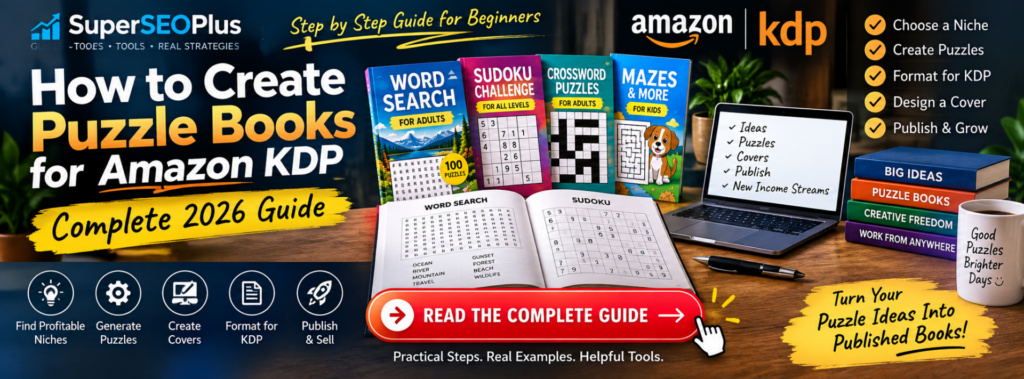
Learn how to create, format and publish puzzle books for Amazon KDP with our complete step-by-step guide.
What Is an Amazon KDP Puzzle Book?
A puzzle book is a book containing interactive puzzles that readers solve directly on the page. Instead of reading the book from beginning to end like a novel, the buyer purchases it for entertainment, mental exercise, education or relaxation.
Common examples include:
- Word search books
- Crossword puzzle books
- Sudoku books
- Maze books
- Cryptogram books
- Word scramble books
- Children's activity books
- Educational puzzle books
- Large-print puzzle books
- Theme-based puzzle collections
Amazon Kindle Direct Publishing (KDP) allows independent publishers to upload print-ready book files. Amazon handles printing and fulfillment when customers order eligible print books.
This removes the need to purchase hundreds of printed books in advance, but it does not remove the work required to create a good book.
Why Are Puzzle Books Interesting for KDP Publishers?
Puzzle books have several characteristics that make them attractive to independent publishers.
First, one puzzle format can be adapted to many audiences. A generic word-search book, for example, can become a gardening word-search book, football word-search book, travel word-search book or an educational vocabulary book.
Second, puzzle books can solve a very specific buyer need. Someone may want an activity book for a road trip, a large-print puzzle book for an older relative, a children's activity book for a holiday or a themed gift for somebody with a particular hobby.
That specificity is important.
Rather than thinking:
"I want to publish a puzzle book."
think:
"What type of person would buy this puzzle book, and why?"
That question should influence your niche, puzzle difficulty, design, title, cover and marketing.
Step 1: Choose a Specific Puzzle Book Niche
One of the biggest mistakes beginners make is creating the book before researching the market.
A better approach is to identify an audience first.
Suppose you want to create a word-search book. Instead of immediately generating 100 random puzzles, research possible themes such as:
- Travel
- Animals
- History
- Gardening
- Food
- Sports
- Science
- Occupations
- Hobbies
- Seasonal events
You can then narrow the idea further by audience, age, difficulty or purpose.
For example:
Broad: Word Search Book
Better: Gardening Word Search Book
More specific: Large-Print Gardening Word Search Book for Adults
The goal is not simply to find a keyword with search volume. You need to understand what already exists and whether you can create something genuinely useful or distinctive.
Check the existing market
Search Amazon for books similar to your idea and study:
- How specific the titles are
- Common book sizes
- Number and variety of puzzles
- Difficulty levels
- Cover styles
- Pricing
- Customer reviews
- Recurring complaints
Reviews can be particularly useful. If readers repeatedly complain about tiny print, poor instructions, repeated puzzles, incorrect answers or insufficient space, those complaints can help you design a better product.
Important: Research competitors for inspiration and market understanding, not for copying their puzzles, artwork, descriptions or other protected content.
Step 2: Decide What Type of Puzzles to Include
You can create a book around one puzzle format or combine several types.
Word searches
Word searches are relatively easy for readers to understand and can work particularly well with themed books.
Crosswords
Crosswords add another level of complexity because you need appropriate clues and accurate answers. Quality control becomes especially important.
Sudoku
Sudoku books can be organized by difficulty, such as beginner, easy, medium and hard.
Mazes
Mazes can work for children as well as adults, depending on the design and difficulty.
Cryptograms and word scrambles
These can add variety to a general puzzle collection and give you additional possibilities for themed books.
The puzzle type should fit the intended reader. A children's activity book and an advanced adult logic-puzzle collection should not have the same visual design or difficulty.
Step 3: Create Your Puzzles
This is where the workload becomes obvious.
If you are creating everything manually, you may need to:
- Research words, clues or themes
- Build each puzzle
- Check for duplicates
- Verify every answer
- Export the puzzle
- Place it into your book layout
- Maintain consistent dimensions
- Repeat the process dozens of times
Creating five puzzles manually may be manageable.
Creating enough unique, checked and consistently formatted puzzles for a complete book is a different task.
This is one reason dedicated puzzle-generation software can become useful.
A Faster Option: Manaka Royalty
Manaka Royalty is a cloud-based puzzle-book creation platform designed for publishers who want to reduce the repetitive work involved in producing puzzle interiors.
According to the developer, the platform can generate several types of puzzles, including word searches, crosswords, Sudoku, mazes, cryptograms and word scrambles.
The advantage is not simply generating one puzzle. The more interesting use case is creating multiple puzzles while keeping the production process inside one workflow.
If you plan to create puzzle books regularly, that can potentially save a significant amount of manual preparation.
See Manaka Royalty and its current features →
Affiliate link: We may receive a commission if you purchase through this link, at no additional cost to you.
Step 4: Create and Verify the Answer Pages
Do not treat solutions as an afterthought.
A puzzle book containing incorrect answers can quickly frustrate readers and damage the quality of the entire product.
For every puzzle, verify that:
- The puzzle is actually solvable
- The intended answer is correct
- The solution corresponds to the correct puzzle
- Nothing is accidentally missing
- Solution pages remain readable when printed
If you create puzzles manually, this verification process can become one of the most time-consuming parts of production.
Manaka Royalty is relevant here because its workflow includes generating solutions alongside supported puzzle types. Even when using automation, however, you should still perform a final human quality check before publishing.
Step 5: Format Your Puzzle Book Interior for Amazon KDP
Generating the puzzles is only part of creating the book.
The finished interior still needs to be prepared correctly for print.
Important considerations include:
- Trim size
- Page margins
- Inside/gutter margins
- Bleed or no bleed
- Image quality
- Page numbering
- Front matter
- Copyright information
- Instructions
- Solution section
Your design should also remain comfortable to use after the book is physically printed and bound.
Do not ignore margins and bleed
Amazon KDP distinguishes between the final trim size of a printed book and bleed, where graphical elements extend beyond the final cutting line.
If your puzzle pages contain graphics or backgrounds that are intended to reach the edge of the printed page, your file needs to be prepared accordingly.
This is exactly the kind of technical detail that can turn a seemingly simple puzzle book into a frustrating project for a first-time publisher.
Before uploading, always compare your final file with Amazon KDP's current publishing specifications rather than relying on an old template or tutorial.
Keep readability ahead of decoration
A beautiful page is useless if the puzzle is uncomfortable to solve.
Check:
- Is the text large enough?
- Is there enough white space?
- Are puzzle grids clear?
- Can readers easily distinguish clues and answers?
- Will important content disappear into the binding?
This becomes even more important when creating books for children or readers who prefer large print.
Step 6: Create a Professional KDP Book Cover
The cover has a completely different job from the interior.
Your puzzles provide the experience after purchase. Your cover has to communicate the book's purpose before purchase.
A good puzzle-book cover should quickly tell a potential buyer:
- What type of puzzle book it is
- Who it is for
- What theme it covers
- Any important differentiator, such as large print or difficulty level
Avoid filling the cover with unnecessary text. It should remain understandable even when displayed as a relatively small thumbnail.
Remember the complete print cover
For a paperback, you are not designing only the front image. The print-ready cover includes the back, spine and front, and its final dimensions depend on factors including trim size and page count.
Amazon provides its own cover tools and templates, so there is no requirement to purchase third-party software just to create a cover.
However, publishers creating multiple books may prefer keeping more of the workflow together. Manaka Royalty's vendor materials describe built-in cover-creation functionality as part of the broader publishing workflow.
We will cover this topic separately in our upcoming guide on how to create a book cover for Amazon KDP.
Step 7: Perform a Complete Quality Check
Automation should reduce repetitive work. It should not eliminate quality control.
Before uploading your book, go through it page by page.
Check for:
- Duplicate puzzles
- Incorrect solutions
- Spelling mistakes
- Inconsistent fonts
- Misaligned elements
- Content too close to the page edge
- Missing pages
- Incorrect page numbers
- Poor-quality graphics
- Blank pages in unintended locations
Also ask yourself a simple question:
If I bought this book, would I feel that I received a professionally prepared product?
If the answer is no, fix it before publishing.
Step 8: Upload and Publish Your Puzzle Book Through Amazon KDP
Once your files are ready, you can create the book through your KDP account.
You will typically need to prepare information such as:
- Book title and subtitle
- Author or publisher information
- Description
- Publishing rights
- Keywords
- Categories
- Print specifications
- Interior manuscript
- Cover file
- Pricing and distribution information
Use KDP's previewing tools carefully before submitting the book.
Do not rush this stage simply because you are excited to publish.
A few extra minutes checking the preview can reveal formatting problems that are much easier to correct before publication.
Manual Creation vs. Using a Puzzle Book Generator
There is no rule saying that you must purchase software to publish puzzle books.
You can build a workflow using spreadsheets, design software, free tools and manual formatting.
For someone experimenting with a first book, that may be perfectly reasonable.
The calculation changes when you want to produce larger books or create multiple titles.
| Task | Manual Workflow | Dedicated Tool |
|---|---|---|
| Create individual puzzles | Possible but repetitive | Can automate supported puzzle generation |
| Create solutions | Requires additional work/checking | Can generate corresponding solutions |
| Maintain consistency | Requires careful templates | More standardized workflow |
| Create many puzzles | Time-intensive | Better suited to repeated production |
| Formatting | Requires manual setup | Some publishing preparation can be streamlined |
| Quality control | Required | Still required |
This is the real reason to consider a tool such as Manaka Royalty.
It is not because software magically turns every book into a successful product. It does not.
Its value proposition is reducing the repetitive production work between having a puzzle-book idea and creating the files needed to turn that idea into a finished book.
Who Should Consider Manaka Royalty?
Manaka Royalty may be worth investigating if you:
- Want to create multiple puzzle books
- Need several different puzzle formats
- Do not want to build every puzzle manually
- Want puzzle solutions generated as part of the workflow
- Prefer having more of the creation process in one platform
- Plan to test several puzzle-book niches
It may be unnecessary if you only want to create one very small book and are comfortable building everything manually.
Explore Manaka Royalty's puzzle-book creation tools →
Always review the current features, pricing and terms on the vendor's page before purchasing.
Can You Make Money Selling Puzzle Books on Amazon KDP?
It is possible to earn money from books published through KDP, but publishing a puzzle book does not guarantee sales or profit.
Results can depend on factors including:
- Demand for the niche
- Competition
- Book quality
- Pricing
- Cover quality
- Keyword targeting
- Customer satisfaction
- Marketing
This distinction matters because software can help you create a product more efficiently, but it cannot guarantee that customers will buy it.
Think of automation as a production advantage—not a substitute for market research, quality or marketing.
7 Common KDP Puzzle Book Mistakes to Avoid
1. Choosing a niche only because it looks popular
High demand can also mean intense competition. Look for a specific audience you can serve well.
2. Publishing dozens of nearly identical books
Focus on usefulness and differentiation rather than simply maximizing the number of uploads.
3. Forgetting to verify solutions
One incorrect solution can undermine the reader's confidence in the rest of the book.
4. Using unreadable puzzle grids
Always evaluate the design at the physical dimensions at which it will be printed.
5. Treating the cover as an afterthought
Your cover is one of the first pieces of information shoppers see.
6. Ignoring KDP formatting requirements
A good book idea can still run into publishing problems if the manuscript dimensions, margins, bleed or cover file are incorrect.
7. Assuming software guarantees sales
A puzzle generator can accelerate production. It cannot replace research, positioning and quality.
A Practical Puzzle Book Workflow
If you are starting today, keep the process simple:
- Choose one audience.
- Research one puzzle-book niche.
- Study competing books and customer feedback.
- Choose one or two appropriate puzzle types.
- Create a small sample first.
- Test readability and difficulty.
- Produce the complete puzzle set.
- Generate and verify solutions.
- Format the interior to current KDP specifications.
- Create the cover.
- Perform a page-by-page quality check.
- Preview the book through KDP.
- Correct any issues before submitting it.
If the manual production work becomes the bottleneck, that is the point at which a dedicated puzzle-book platform becomes much easier to justify.
See how Manaka Royalty approaches the puzzle creation workflow →
Frequently Asked Questions
Can I create puzzle books for Amazon KDP?
Yes. Independent publishers can create puzzle and activity books for KDP as long as the books and uploaded files comply with Amazon's current content and publishing requirements.
What types of puzzle books can I create?
Common formats include word searches, Sudoku, crosswords, mazes, cryptograms and word scrambles. You can also combine different activities when appropriate for the intended audience.
Do I need special software to make KDP puzzle books?
No. Puzzle books can be created manually using different design and puzzle-generation tools. Dedicated software becomes more attractive when you want to reduce repetitive work or produce books regularly.
What is a puzzle book generator?
A puzzle book generator is software that automates some or all of the puzzle-creation process. Depending on the tool, this may include generating puzzle grids, clues, answers, solution pages or exportable files.
Does Manaka Royalty work with Amazon KDP?
Manaka Royalty is marketed by its developer toward puzzle and activity-book publishers, including people preparing books for Amazon KDP. Because KDP requirements can change, you should still verify your final files against Amazon's current specifications before uploading them.
Does Manaka Royalty guarantee that my puzzle books will sell?
No tool can guarantee that a book will sell. Software can help with production, while sales depend on factors such as market demand, competition, product quality, positioning, pricing and promotion.
Should beginners use a puzzle book generator?
It depends on your goal. If you are experimenting with a single simple book, a manual workflow may be enough. If you intend to produce many puzzles or test several book ideas, automation can save considerable repetitive work.
Final Thoughts: Start With the Reader, Not the Software
Learning how to create puzzle books for Amazon KDP is not simply a matter of finding a generator and clicking a button.
A successful publishing workflow begins with understanding the reader.
Choose a clear audience. Research what they want. Create enjoyable puzzles. Check every solution. Make the book comfortable to use. Prepare the files correctly and give the book a cover that clearly communicates its value.
You can perform much of that process manually.
But once puzzle generation, solutions and production become repetitive, automation can make considerably more sense. That is where a platform such as Manaka Royalty becomes relevant.
Instead of viewing it as a shortcut to guaranteed income, consider it for what it is intended to be: a tool for making puzzle-book production faster and more manageable.
View Manaka Royalty's current features and offer →
Disclosure: The link above is an affiliate link. SuperSEOPlus may receive a commission if you purchase through it, without increasing your purchase price.
About us and this blog
We are a digital marketing company with a focus on helping our customers achieve great results across several key areas.
Request a free quote
We offer professional SEO services that help websites increase their organic search score drastically in order to compete for the highest rankings even when it comes to highly competitive keywords.
More from our blog
See all posts






Recent Posts
- Service-Area Business on Google Maps: How to Set It Up Properly October 20, 2026
- SEO Backlinks Explained: How They Work and How to Earn Them October 19, 2026
- On-Page SEO Checklist: 13 Checks for Every Page October 18, 2026