Best AI SEO Tools in 2026: 15 Tools Compared for SEO, Content and AI Search
- October 4, 2026
- AI Tools
Shopping for AI SEO tools in 2026 is confusing because the label now covers very different products. Some are classic SEO platforms with AI features added. Some optimise content. Some track whether ChatGPT, Gemini or Google's AI Overviews mention your brand. Others automate workflows, or are general assistants you happen to use for SEO.
Comparing all of them as if they did the same job leads to bad purchases. This guide sorts 15 tools into clear categories, compares them on the same fields, and tells you who should choose each one, and who should skip it.
Some links in this guide may be affiliate links. If you purchase through them, we may earn a commission at no additional cost to you. This does not affect which tools we include or how we compare them.
In this guide
- Best AI SEO tools at a glance
- What are AI SEO tools?
- How we compared these AI SEO tools
- Best all-in-one AI SEO platforms
- Best AI content optimization tools
- Best AI search visibility and GEO tools
- Best AI SEO automation and technical SEO tools
- Best free AI SEO tools
- Which AI SEO tool should you choose?
- How reliable is AI SEO keyword data?
- Limitations of AI SEO tools
- Frequently asked questions
- Final thoughts
Best AI SEO Tools at a Glance
The table compares all 15 tools on the same fields. "Starting price" is the lowest published paid tier, in USD, as listed on each vendor's official pricing page when we checked in October 2026. Where a vendor did not show a clear public price, we say "check current pricing" rather than guess.
On a phone, swipe the table sideways to see every column.
| Tool | Category | Best for | Google SEO | AI search / GEO | Free plan / trial | Starting price (Oct 2026) | GSC integration | Small business | Affiliate / blogger | Main limitation |
|---|---|---|---|---|---|---|---|---|---|---|
| Semrush | All-in-one platform | One suite for research, audits and AI visibility | Yes | Yes (SEO + AI plans) | Limited free plan; 7-day trial | $139/mo (SEO, monthly); $199/mo with AI visibility | Yes | Fair | Fair | Price climbs quickly with AI tracking and extra users |
| Ahrefs | All-in-one platform | Backlink and competitor research | Yes | Yes (Brand Radar) | Ahrefs Free for your own site; no trial | $29/mo Starter; $129/mo Lite | Yes (GSC Insights) | Fair | Good | Serious AI tracking is a separate cost |
| SE Ranking | All-in-one platform | Affordable SEO + GEO in one plan | Yes | Yes (prompts included) | 14-day trial, no card | $129/mo monthly ($103.20 annual) | Yes | Good | Good | Smaller backlink and content toolset than the biggest suites |
| Search Atlas | All-in-one + automation | Automated on-page fixes (OTTO) | Yes | From Growth plan | 7-day trial | $79/mo billed annually | Check docs | Fair | Fair | Automation needs careful review before it touches a live site |
| Surfer | Content optimization | Writing and optimising articles against the SERP | Yes | Yes (AI tracking) | "Start for free" option; check terms | $49/mo billed yearly | Check docs | Good | Very good | Not a backlink or deep keyword research tool |
| Frase | Content optimization | Briefs and content for Google and AI answers | Yes | Yes (ChatGPT, Google AI on entry plan) | 7-day trial, no card | $49/mo monthly ($39 billed yearly) | Check docs | Very good | Very good | Entry plan has tight article and audit limits |
| Clearscope | Content optimization | Editorial teams optimising human-written content | Yes | Yes (ChatGPT, Gemini queries) | 14-day trial | $129/month | Check docs | Fair | Fair | Expensive for solo bloggers |
| Writesonic | AI visibility (GEO) + AI writing | Tracking AI answers and producing content to close gaps | Partial | Yes (core focus) | Free trial | $79/mo billed annually | Check docs | Fair | Good | Entry plan tracks only ChatGPT, Gemini and AI Overviews |
| Profound | AI visibility (GEO) | Enterprise AI search programmes | No | Yes (core focus) | Free 7-day trial | Custom (Enterprise) | Check docs | Poor | Poor | No public self-serve price |
| Peec AI | AI visibility (GEO) | Teams wanting focused AI search analytics | No | Yes (core focus) | Check current terms | Check current pricing | Check docs | Fair | Fair | Monitoring only; not a traditional SEO tool |
| AirOps | Workflow automation | Teams automating research, briefs and refreshes | Partial | Yes | "Start free" option | Check current pricing | Check docs | Poor | Fair | Positioned for enterprise teams; setup takes effort |
| Screaming Frog | Technical SEO | Deep crawls, with optional AI prompts | Yes | Indirect | Free up to 500 URLs | $279 per licence per year | Yes | Good | Good | Desktop software with a learning curve |
| Indexly | Technical SEO / indexing + AI visibility | Indexing monitoring and AI visibility for smaller sites | Yes | Yes (module) | Check current terms | $99/month (AI Visibility module) | Check docs | Good | Good | Pricing is split by module, so compare carefully |
| Google Search Console | Free data source | Real Google clicks, impressions and indexing | Yes | No dedicated AI report | Fully free | $0 | — | Essential | Essential | Shows your own site only; no competitor data |
| ChatGPT | General AI assistant | Drafting, outlining and analysing exported data | Indirect | Indirect | Free plan | Free; paid plans: check current pricing | No (unless connected) | Good | Good | No search-volume or ranking data of its own |
Quick matches by use case (fit, not scores):
- One subscription for SEO and AI visibility: Semrush or SE Ranking.
- Backlink and competitor research: Ahrefs.
- Writing and optimising articles: Surfer or Frase. Clearscope suits larger editorial teams.
- Dedicated AI search monitoring: Writesonic, Peec AI, or Profound at enterprise scale.
- Technical audits on a budget: Screaming Frog plus Google Search Console.
- Spending nothing: Google Search Console, Screaming Frog's free version, Ahrefs Free and ChatGPT's free plan.
What Are AI SEO Tools?
AI SEO tools are software products that use machine learning or large language models to speed up or improve part of the search optimisation process. That could be clustering keywords, scoring a draft against top-ranking pages, writing metadata, flagging technical issues, or tracking how AI assistants describe your brand.
In 2026 the term has stretched. It now describes at least seven different kinds of product:
- Traditional SEO platforms enhanced with AI – Semrush, Ahrefs, SE Ranking, Search Atlas.
- Keyword and data research tools – the research modules inside those suites, plus Google's own data in Search Console and Keyword Planner.
- AI content optimization tools – Surfer, Frase, Clearscope.
- Technical SEO tools using AI or automation – Screaming Frog, Indexly, and Search Atlas's automated fixes.
- AI search visibility / GEO / AEO tracking tools – Writesonic, Profound, Peec AI, and the AI modules inside the big suites.
- SEO workflow automation tools – AirOps.
- General AI assistants useful for SEO – ChatGPT and similar assistants.
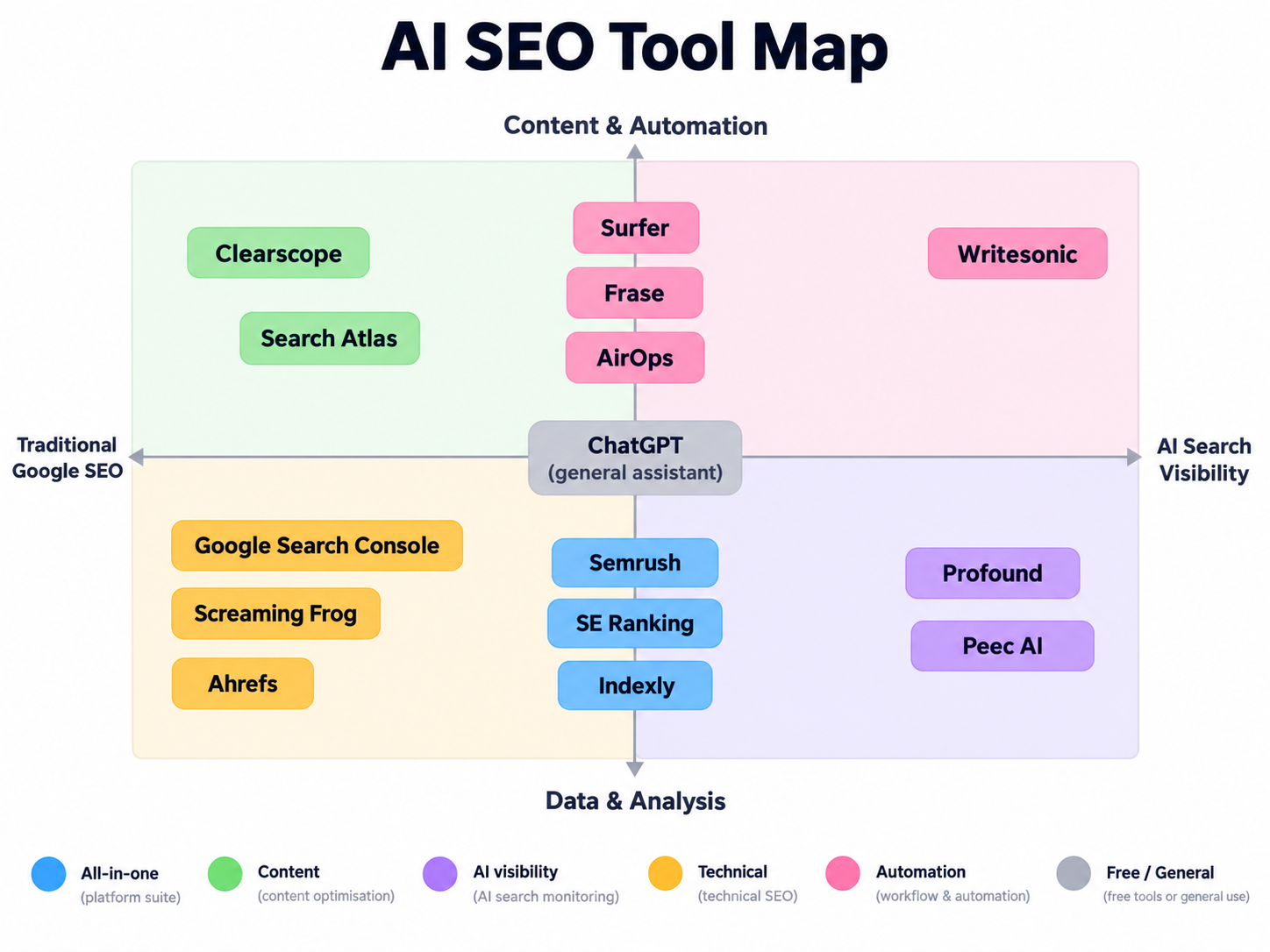
AI SEO tool map: where each type of tool sits, from Google SEO to AI search visibility, and from analysis to content and automation.
A content optimiser and an AI visibility tracker are not competitors. Asking "which is better, Surfer or Profound?" is like asking whether a word processor beats an analytics dashboard. Decide which job you need done first, then compare tools within that category.
Traditional Google SEO vs AI search / GEO
Traditional SEO aims for rankings and clicks in Google's organic results. It is measured with rankings, impressions, clicks and conversions, and much of that data comes from Google Search Console.
AI search optimisation aims for mentions and citations inside generated answers from ChatGPT, Gemini, Perplexity, Google AI Overviews and AI Mode. You will see it called generative engine optimisation (GEO), answer engine optimisation (AEO) or LLM optimisation. GEO was formalised in a 2023 research paper of that name. Its metrics are newer and less standardised: prompt "visibility", mention rate, citation share and sentiment.
The two overlap more than the jargon suggests. Google's own documentation on AI features and your website says the same foundational SEO best practices apply to its AI features. Treat AI visibility as an extra layer of measurement on top of solid SEO, not a replacement for it.
How We Compared These AI SEO Tools
We want to be precise about what this comparison is, and what it is not.
This is a documentation-based comparison, not a hands-on product test. We have not run every tool on this list through a controlled test, and we do not claim performance results for them.
Here is what the comparison is based on:
- Official pricing pages. Every price was checked on the vendor's own site in October 2026, in USD. We note whether a price is billed monthly or annually, and whether AI visibility is included or sold as an add-on.
- Official product and feature pages, used to confirm what each tool does and which AI platforms it says it tracks.
- Live search results for "ai seo tools" and "best ai seo tools", to see which tools searchers and Google's AI Overviews commonly reference.
- Our own first-hand data work. We pulled keyword volumes directly from Google's Keyword Planner API and compared them with a third-party tool. That small experiment is described in the keyword data section.
We did not assign star ratings or "9.5/10" scores, because we have no objective testing method that would justify them. Instead, each tool gets the same decision-focused fields: what it does, best for, strengths, main limitation, pricing, who should choose it and who should skip it.
Pricing and features in this category change often. Treat every price below as a snapshot from October 2026, and confirm on the vendor's site before you buy.
Best All-in-One AI SEO Platforms
These are traditional SEO suites that have added AI features and, increasingly, AI visibility tracking. Choose this category if you want one login for keyword research, rank tracking, site audits and competitor analysis.
1. Semrush
- What it does: A broad SEO and marketing suite. In 2026 its plans are organised around "SEO + AI Search": classic keyword research, position tracking and site audits, plus prompt tracking across AI platforms.
- Best for: Marketers and agencies who want one platform to cover both Google rankings and AI visibility.
- Key strengths: Breadth. The Starter (SEO + AI Search) plan bundles 50 daily tracked AI prompts with core SEO tools, so you don't have to buy and connect a separate GEO tracker.
- Main limitation: Cost. Extra users, reporting add-ons and higher AI prompt limits all push the bill up.
- Pricing / access (Oct 2026): A free plan with 1 demo project and 10 reports per day. Paid plans: SEO at $139/month on monthly billing ($117.33/month billed annually), and Starter with AI visibility at $199/month ($165.17/month billed annually). A 7-day free trial is offered. Official pricing.
- Choose it if: You manage several sites or clients and value having everything in one place over the lowest price.
- Skip it if: You run one small blog and mainly need content optimisation. The suite will be underused.
2. Ahrefs
- What it does: An SEO platform known for its backlink index and competitor research. It also includes keyword research, site audits, rank tracking and Brand Radar for AI visibility.
- Best for: Link builders, competitive researchers and affiliate publishers who study what competitors rank for.
- Key strengths: Competitive and link data. A low-cost Starter plan, and Ahrefs Free gives limited Site Explorer and Site Audit access for sites you verify.
- Main limitation: AI tracking at scale costs extra. Lite includes only 5 tracked AI prompts; Brand Radar AI starts from $199/month. There is no free trial and, per Ahrefs, no discounts.
- Pricing / access (Oct 2026): Ahrefs Free; Starter $29/month; Lite $129/month; Standard $249/month; Advanced $449/month. Annual billing saves up to 17%. Content Kit (AI Content Helper) from $99/month as an add-on. Official pricing.
- Choose it if: Competitor and backlink research drives your decisions.
- Skip it if: AI visibility tracking is your main goal and your budget is tight.
3. SE Ranking
- What it does: An SEO platform with rank tracking, audits, keyword and backlink research. GEO features (AI prompt tracking and AI competitor research) are built into its main plans.
- Best for: Small businesses, freelancers and small agencies that want SEO and AI visibility at a mid-range price.
- Key strengths: Value. Core includes 2,000 tracked keywords and 100 AI prompts tracked daily, plus GA and GSC integrations. A no-card 14-day trial makes it easy to evaluate.
- Main limitation: Its research and content tools are less extensive than the largest suites. Broader AI platform coverage comes through a separate AI Search add-on.
- Pricing / access (Oct 2026): Core $129/month on monthly billing ($103.20/month billed annually); Growth $279/month ($223.20 annually). AI Search add-on $89/month ($71.20 annually). 14-day free trial. Official pricing.
- Choose it if: You want one affordable platform covering both Google SEO and basic AI visibility.
- Skip it if: You need the deepest backlink database available.
4. Search Atlas
- What it does: An SEO platform built around automation. Its OTTO SEO feature is designed to apply technical and on-page improvements, alongside content tools and CMS publishing.
- Best for: Teams who want automation to implement routine on-page changes, not just report on them.
- Key strengths: It acts, rather than only analyses. AI visibility tracking (ChatGPT, Gemini and Google AI Mode) arrives on the Growth plan.
- Main limitation: Automated changes to a live site need human oversight. AI visibility is not on the entry plan.
- Pricing / access (Oct 2026): Starter $79/month billed annually ($950/year); Growth $159/month billed annually. 7-day trial. Monthly billing costs more. Official pricing.
- Choose it if: You are comfortable reviewing automated changes and want to cut manual implementation work.
- Skip it if: You prefer full manual control over every edit to your site.
Best AI Content Optimization Tools
Content optimisation tools analyse pages that already rank for a query. They then guide what you write: topics to cover, related terms, structure and length. All three below now add some form of AI answer tracking too.
5. Surfer
- What it does: A content editor that scores drafts against search results, with AI writing assistance, content audits and AI visibility tracking on most plans.
- Best for: Bloggers, affiliate publishers and content teams producing articles regularly.
- Key strengths: A writing-first workflow. Standard tracks 25 AI prompts weekly; Pro tracks 50 daily. A standalone AI visibility plan ($82/month billed yearly) is also available.
- Main limitation: It doesn't replace a full SEO suite for backlinks or deep keyword research.
- Pricing / access (Oct 2026): Discovery $49/month, Standard $99/month, Pro $182/month, all billed yearly. Monthly billing costs more. The pricing page offers a "Start for Free" option; check what it includes before relying on it. Official pricing.
- Choose it if: Publishing optimised articles is the core of your SEO.
- Skip it if: You rarely publish new content and mostly need technical or link work.
See Surfer's current plans
6. Frase
- What it does: A content platform for research, briefs, writing and optimisation for both Google and AI answers. It includes SEO and GEO scores and CMS publishing.
- Best for: Solo creators, freelancers and single-site teams on a budget.
- Key strengths: The lowest-priced entry among the content tools here. AI visibility on ChatGPT and Google AI is included even on Starter, and the trial needs no card.
- Main limitation: Starter is capped at 10 articles and 50 audit pages a month. Perplexity, Claude and Gemini tracking only arrive on higher plans.
- Pricing / access (Oct 2026): Starter $49/month on monthly billing ($39/month billed yearly); Professional $129/month ($103 yearly); Scale $299/month ($239 yearly). Free 7-day trial, no credit card. Official pricing.
- Choose it if: You are a solo or small-team publisher wanting briefs, optimisation and basic AI visibility for under $50 a month.
- Skip it if: You publish at high volume across many sites and would quickly outgrow entry limits.
See Frase's current plans
7. Clearscope
- What it does: A content optimisation platform focused on human-written content. It includes query tracking in ChatGPT and Gemini on every plan.
- Best for: Editorial and content marketing teams with several writers.
- Key strengths: Unlimited users and projects on every plan, which suits collaborative teams. No minimum contract on monthly plans.
- Main limitation: At $129/month to start, it is expensive for an individual blogger.
- Pricing / access (Oct 2026): Essentials $129/month; Business $399/month; Enterprise custom. 14-day free trial. Official pricing.
- Choose it if: A team of writers needs a shared, consistent optimisation standard.
- Skip it if: You are a single creator watching costs; Frase or Surfer's lower tiers fit better.
Best AI Search Visibility and GEO Tools
These tools are built mainly to monitor how AI systems mention and cite brands. They answer questions like: when someone asks ChatGPT for the best tool in your category, does your brand appear, and which sources is the answer drawing on?
Several platforms above (Semrush, Ahrefs, SE Ranking, Surfer, Frase, Clearscope) also include AI tracking. A dedicated tool makes most sense when AI visibility is a priority in its own right.
8. Writesonic
- What it does: Now positioned as an AI search visibility platform. It tracks brand presence in AI answers and combines that with AI article generation and site audits to close gaps.
- Best for: Brands and affiliate publishers who want monitoring and content creation in one place.
- Key strengths: Tracking leads to action: entry plans bundle AI articles and site audits with prompt tracking.
- Main limitation: Starter tracks ChatGPT, Gemini and Google AI Overviews only. Sentiment analysis and the Action Center sit on higher tiers.
- Pricing / access (Oct 2026): Starter $79/month billed annually (50 prompts tracked daily, 15 AI articles a month); Basic $199/month and Growth $399/month billed annually. Free trial available. Official pricing.
- Choose it if: You want to see where AI answers skip your brand, and produce content to respond.
- Skip it if: You only need classic Google rank tracking.
See Writesonic's current plans
9. Profound
- What it does: An AI search platform for larger organisations. It covers prompt tracking across answer engines and an "AI Marketer" assistant for research, writing and reporting.
- Best for: Enterprise brands and agencies running AI search as a formal programme.
- Key strengths: Built for scale, with up to 9 answer engines, SSO/SAML and dedicated support on Enterprise.
- Main limitation: No public self-serve paid plan; Enterprise pricing is custom.
- Pricing / access (Oct 2026): Free 7-day trial (50 prompts daily across ChatGPT, Gemini and Google AI Overviews), then Enterprise custom pricing. Official pricing.
- Choose it if: You need enterprise-grade AI visibility measurement and have the budget to match.
- Skip it if: You are a small business or solo publisher.
10. Peec AI
- What it does: An AI search analytics tool for marketing teams and SEO agencies, tracking brand visibility across AI platforms.
- Best for: SEO and content managers who want focused AI visibility monitoring without a full suite.
- Key strengths: Every listed plan includes unlimited users and daily tracking. Starter covers 50 prompts across 3 chosen models.
- Main limitation: Monitoring only. It doesn't replace keyword research, audits or rank tracking.
- Pricing / access (Oct 2026): Check current pricing; we could not confirm plan prices from the official page when we checked. Official pricing.
- Choose it if: You already have an SEO suite and want a dedicated, team-friendly AI visibility layer.
- Skip it if: You want one tool to do everything.
How reliable is AI visibility tracking?
AI visibility data is useful, but it is less stable than Google rank tracking. Keep these limitations in mind before acting on a visibility score:
- Answers vary. Generative systems can give different answers to the same prompt at different times, for different users and in different locations. A single check is a sample, not a fixed "ranking".
- Prompts are chosen, not measured. Unlike keyword volumes, there is no public dataset showing how often real people type a specific prompt. Your visibility score depends heavily on which prompts you choose to track.
- Collection methods differ. Vendors gather AI answers in different ways and cover different platforms and countries, so scores from two tools are not directly comparable.
- Coverage depends on your plan. Entry plans often track only two or three AI platforms.
Use AI visibility tools to spot direction and patterns over weeks, such as consistently missing from category prompts or competitors cited where you are not. Don't treat day-to-day movements as precise measurements.
Best AI SEO Automation and Technical SEO Tools
11. AirOps
- What it does: A workflow platform for building multi-step AI processes for content creation, refreshes and AI search work.
- Best for: Content operations teams that run the same SEO processes repeatedly and at volume.
- Key strengths: It automates whole processes, from research to brief to refresh, rather than single tasks.
- Main limitation: Its pricing page is aimed at enterprise teams, and building reliable workflows takes time.
- Pricing / access (Oct 2026): "Start free or talk to sales"; check current pricing. Official pricing.
- Choose it if: You have repeatable content processes and the resources to build and maintain automation.
- Skip it if: You publish a few articles a month. The setup effort won't pay back.
12. Screaming Frog SEO Spider
- What it does: A desktop crawler that audits websites for technical issues such as broken links, redirects, metadata and duplicate content. It can also connect to OpenAI and Gemini to run AI prompts during a crawl.
- Best for: Anyone doing hands-on technical SEO, from site owners to specialists.
- Key strengths: A genuinely useful free version, and a low annual price for the full tool.
- Main limitation: A desktop application with a learning curve, and the free version stops at 500 URLs.
- Pricing / access (Oct 2026): Free version up to 500 URLs; paid licence $279 per user per year. Official pricing.
- Choose it if: You want control over technical audits without a monthly subscription.
- Skip it if: You want a cloud dashboard with no installation and plain-English explanations.
13. Indexly
- What it does: A platform combining indexing monitoring with AI visibility tracking and content features, sold as separate modules.
- Best for: Smaller sites that care about pages being discovered and want light AI visibility tracking.
- Key strengths: The AI Visibility module includes hallucination detection and brand sentiment alongside prompt tracking.
- Main limitation: Modular pricing makes total cost harder to compare. It can't make low-quality pages worth indexing.
- Pricing / access (Oct 2026): AI Visibility module $99/month (2 sites, 100 prompts, 3 AI models). Annual billing is discounted by 17%. Check current pricing for the SEO and indexing module. Official pricing.
- Choose it if: Indexing delays and AI visibility are both concerns on a small number of sites.
- Skip it if: Your pages index normally. Search Console already covers basic monitoring.
Best Free AI SEO Tools
"Free" means different things on vendor pages. Here is how the free options above actually work:
| Tool | Type of free access | What you actually get |
|---|---|---|
| Google Search Console | Fully free | Your site's real Google clicks, impressions, queries and indexing status |
| Screaming Frog | Free version with a limit | Crawl up to 500 URLs |
| Ahrefs Free | Limited free utility | Limited Site Explorer and Site Audit for verified sites |
| Semrush Free | Limited free plan | 1 demo project, 10 reports per day |
| ChatGPT Free | Free plan | General AI assistance with usage limits; no search data of its own |
| SE Ranking, Clearscope | Free trial (14 days) | Time-limited access, then paid |
| Frase, Search Atlas, Semrush, Profound | Free trial (7 days) | Time-limited access, then paid or a sales call |
Google Search Console is the one free tool every site owner should use. It is Google's own data about your site, not an estimate. It has no AI writing features, but it gives you the facts the AI tools should be checked against. Google Search Console.
ChatGPT (and similar assistants) can draft outlines, rewrite meta descriptions, group exported keywords and explain technical issues. On its own it has no search volumes, rankings or crawl data, so pair it with real data and fact-check what it produces.
Which AI SEO Tool Should You Choose?
Start from your situation, not from a "best tool" list.
For small businesses
Start with Google Search Console and the free version of Screaming Frog. If you need a paid platform, SE Ranking is the most balanced fit here: SEO and basic AI visibility in one plan, plus a no-card trial. If you publish content regularly, add Frase rather than a second suite.
For bloggers and affiliate marketers
Your revenue depends on articles ranking, so a content tool usually comes first: Frase or Surfer. Add Ahrefs (even Starter) if you need to research what competing affiliate sites rank for. For more on using AI across an affiliate business, see our guides to AI tools for affiliate marketing and affiliate automation.
For agencies
Agencies usually need multi-project limits, reporting and client-ready AI visibility data. Semrush or SE Ranking fit as the core platform, with Ahrefs where link research is central. Add Screaming Frog for technical audits.
For content teams
Clearscope suits teams with several writers because every plan allows unlimited users. Surfer and Frase suit teams that also want AI writing assistance. Larger teams with repeatable processes can consider AirOps. Our guide to AI tools for content creators covers the wider content stack.
For AI search / GEO monitoring
If you already have an SEO suite, check whether your plan's AI tracking is enough before buying another tool. If it isn't, Writesonic or Peec AI suit most teams, and Profound suits enterprises. Track a fixed set of prompts over time rather than reacting to single checks.
Budget stacks
Prices below are as published in October 2026; confirm before buying.
- $0 per month: Google Search Console, Screaming Frog (free, up to 500 URLs), Ahrefs Free for your verified site, and ChatGPT's free plan.
- Under $50 per month: The $0 stack plus one of: Frase Starter ($39/month billed yearly, or $49 monthly), Surfer Discovery ($49/month billed yearly), or Ahrefs Starter ($29/month). Pick Frase or Surfer if writing is your bottleneck, Ahrefs Starter if research is.
- Under $150 per month: The $0 stack plus one core platform: SE Ranking Core ($129/month, includes 100 daily AI prompts), Semrush SEO ($139/month), or Ahrefs Lite ($129/month). A cheaper alternative is Frase Starter plus Ahrefs Starter (about $68–78/month, depending on billing).
How Reliable Is AI SEO Keyword Data?
Every AI SEO tool is only as good as the data underneath it. Keyword volume is the clearest example: tools show search volumes, but they don't always explain where those numbers come from.
We ran a small check of our own. We set up direct access to Google's Keyword Planner through the Google Ads API. We then pulled average monthly US search volumes (English, Google Search) for eight keywords related to this topic and compared them with the figures shown by WriterZen, a third-party keyword tool.
| Keyword | Google Keyword Planner API | WriterZen | Match |
|---|---|---|---|
| ai seo tools | 2,400 | 2,400 | Exact |
| best ai seo tools | 1,000 | 1,000 | Exact |
| ai tools for content creation | 1,900 | 1,900 | Exact |
| ai content creation tools | 1,300 | 1,300 | Exact |
| automate content creation | 260 | 260 | Exact |
| ai tools for affiliate marketing | 170 | 170 | Exact |
| how to find low competition keywords | 140 | 140 | Exact |
| wordpress seo audit | 110 | 110 | Exact |
What this shows: for these eight keywords, WriterZen's figures reproduced the Google Keyword Planner API values exactly.
What it does not show: eight observations can't tell us how WriterZen sources its data internally, or whether it matches Google for every keyword, country or time period. Nor does it tell us anything about other tools.
Practical lessons from the exercise:
- Averages hide trends. "best ai seo tools" averaged 1,000 searches a month over 12 months, yet Keyword Planner reported 480 in February 2026 and 1,600 in both July and August 2026. "ai seo tools" averaged 2,400 but was 1,300 in August 2026. Always look at the monthly history, not just the average.
- Spot-check against the source. If a tool's volumes drive real decisions, compare a sample with Google's own Keyword Planner data.
- Ads competition is not SEO difficulty. Keyword Planner's "competition" measures advertiser competition in Google Ads, not how hard it is to rank organically.
Limitations of AI SEO Tools
- Human review is still required. AI-written drafts, outlines and automated fixes can be generic or wrong. Someone with subject knowledge should review anything before it is published or applied to a live site.
- Hallucinations and inaccuracies. General assistants can produce confident but false statements, invented statistics or broken references. Verify facts against primary sources.
- Data is estimated. Outside Google's own tools, traffic and difficulty figures are third-party estimates and models.
- AI visibility is volatile. As covered above, AI answer tracking samples a moving target.
- Pricing and add-ons add up. AI tracking is often an add-on or higher-tier feature. Extra users, prompts, articles and reports raise costs. Compare the plan you actually need, not the headline price.
- Automation risks. Publishing or changing pages at scale without review can spread mistakes across a whole site.
- Google's policies still apply. Google's guidance on AI-generated content focuses on whether content is helpful, not how it was produced. Its spam policies cover mass-produced content made mainly to manipulate rankings. Use AI tools to produce helpful, people-first content, not more pages for their own sake.
If you would rather have a specialist review your site's technical health before investing in tools, you can request a free SEO analysis from our team.
Frequently Asked Questions
Can SEO be done by AI?
Parts of it, yes: keyword grouping, first drafts, metadata suggestions, crawl analysis and monitoring can all be accelerated. Strategy, judgement, original expertise, fact-checking and relationship-based work such as earning links still need people. AI is best treated as an assistant to an SEO process, not a replacement for one.
What is AI SEO called now?
There is no single agreed term. Optimising for AI-generated answers is commonly called generative engine optimisation (GEO), answer engine optimisation (AEO), LLM optimisation, or simply AI search optimisation. "AI SEO" can mean either using AI to do SEO, or optimising for AI search. Check which one a tool means.
Can ChatGPT help with SEO?
Yes, for drafting, outlining, rewriting, brainstorming and analysing data you export from SEO tools. It doesn't provide search volumes, rankings or crawl data of its own, so pair it with Google Search Console or an SEO platform and verify what it writes.
Which AI is best for SEO?
It depends on the job. For an all-in-one platform, look at Semrush, SE Ranking or Ahrefs. For writing and optimising content, Surfer, Frase or Clearscope. For tracking AI answers, a dedicated tool such as Writesonic, Peec AI or Profound. For general help, an assistant like ChatGPT. The comparison table above maps each tool to its job.
Are there free AI SEO tools?
Yes, with limits. Google Search Console is fully free. Screaming Frog is free up to 500 URLs. Ahrefs Free and Semrush's free plan offer limited access, and ChatGPT has a free plan. Many others offer 7- or 14-day free trials rather than free plans.
Is SEO still worth it in 2026?
For most sites, yes. Google's documentation says its AI features build on the same foundational SEO practices, and AI answers frequently draw on and link to web pages. What has changed is measurement: many teams now track AI visibility alongside rankings and clicks.
Final Thoughts
The best AI SEO tools for you depend on which job you need done. Use this framework before buying:
- Name the job. Research, content, technical health, AI visibility, automation, or general assistance?
- Start with free, first-party data. Set up Google Search Console before paying for estimates.
- Pick one tool per job. Avoid two suites that overlap.
- Check what's really included. AI visibility, users and prompt limits often sit in higher tiers or add-ons.
- Use the trial with a plan. Decide in advance what the tool must show you before the trial ends.
- Keep humans in the loop. Review AI output and automated changes before they go live.
Choose AI SEO tools that fit your real workflow and budget, and they will save time. Choose them because they are labelled "best", and you will mostly pay for features you don't use.
Pricing and features were checked on official vendor websites in October 2026 and may have changed since. Please confirm current details with each vendor before purchasing.
SuperSEOPlus Editorial is the editorial byline for articles published on SuperSEOPlus. It is a publication byline, not an individual author. The guides cover SEO, local SEO, link building, content marketing, WordPress and digital marketing, and aim to explain how these topics work in practical terms. Where an article recommends third-party tools or products, any affiliate relationship is disclosed in the article. We do not guarantee rankings, traffic or income.
About us and this blog
We are a digital marketing company with a focus on helping our customers achieve great results across several key areas.
Request a free quote
We offer professional SEO services that help websites increase their organic search score drastically in order to compete for the highest rankings even when it comes to highly competitive keywords.
More from our blog
See all posts
Recent Posts
- Why Is My Business Not Showing on Google Maps? 10 Causes and Fixes October 26, 2026
- Local SEO for Plumbers: How to Get Found by Customers Nearby October 25, 2026
- NAP Consistency: What It Is, Why It Matters and How to Fix It October 25, 2026