Most backlink advice falls into two camps: "just write great content and links will come", which rarely happens on its own, and "buy 500 links for £20", which is how sites get into trouble. The reality sits in between. Links are earned through useful assets plus deliberate, manual outreach. This guide shows you how to build backlinks with twelve proven manual methods, ranked roughly from easiest to most advanced.
First: What Counts as a High-Quality Backlink?
Before you build anything, know what you're aiming for. High-quality backlinks share four traits:
- Relevant: the linking site covers your topic, industry or location.
- Editorial: the link is placed within real content because it helps readers.
- From a real site: it has genuine traffic, original content and isn't a link farm.
- Natural: the anchor text reads normally, not like a forced keyword.
For a deeper explanation, read SEO backlinks explained.
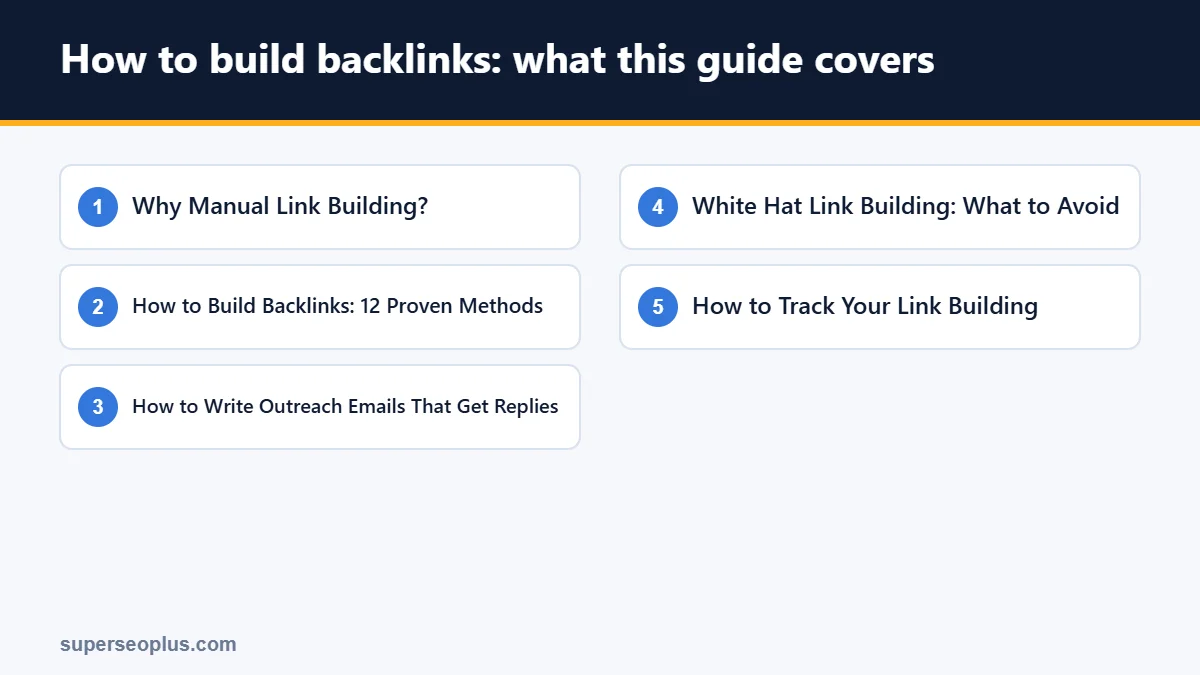
Why Manual Link Building?
Manual link building means a person researches, contacts and secures each link, rather than software blasting links across thousands of sites. It's slower, but it's the approach that holds up over time. Google's link spam policies specifically call out automated link creation.
How to Build Backlinks: 12 Proven Methods
1. Claim your business profiles and citations
Start with Google Business Profile, Bing Places, Apple Business Connect, your industry associations and trusted local directories. These links are easy to get and support local rankings. See our guide to local citation building.
2. Ask partners, suppliers and clients
Businesses you already work with often have "partners", "stockists" or "case studies" pages. A friendly email asking to be listed is one of the highest-success outreach emails you'll ever send.
3. Reclaim unlinked brand mentions
Search for your brand name in quotes, excluding your own site. Where someone mentions you without linking, thank them and politely ask for a link. The relationship already exists, so success rates are high.
4. Fix broken links pointing to your site
Use Google Search Console or an SEO tool to find external links pointing to pages on your site that now return 404 errors. Redirect those URLs to the most relevant live page and you recover the link value instantly.
5. Create a genuinely linkable asset
People link to things that save them time: original statistics, checklists, templates, calculators, in-depth guides. Our own on-page SEO checklist is an example. Build the asset first, then promote it with methods 6–12.
6. Resource page link building
Search for "your topic" + "useful resources" or "your topic" inurl:resources. Where your asset genuinely fits, email the page owner with a short, specific suggestion.
7. Broken link building
Find dead links on relevant pages, create (or point to) a useful replacement on your site, and let the site owner know. You're doing them a favour, which makes outreach easier.
8. Guest contributions
Write a genuinely useful article for a respected site in your industry. Focus on quality publications with real readers, not "write for us" sites that publish anything for a fee.
9. Expert quotes for journalists
Platforms that connect journalists with sources, along with journalist requests on social media, let you supply expert comments in exchange for a mention and often a link. Respond fast and keep answers specific.
10. Original data and surveys
Run a small survey of your customers or analyse data you already hold, then publish the findings. Journalists and bloggers love new statistics and cite the source.
11. Skyscraper-style content improvement
Find a popular piece of content with many links that is now outdated. Create a clearly better, current version, then contact sites linking to the old one. This only works if yours is genuinely better.
12. Local and community involvement
Sponsor a local event, support a charity, host a workshop or join a business network. These generate real local mentions and links, plus actual customers.
How to Write Outreach Emails That Get Replies
- Personalise: mention the specific page and why your link helps their readers.
- Be short: four or five sentences.
- Lead with value, not with your request.
- Follow up once, politely, after about a week, then stop.
Example outreach email:
Hi [Name],
I was reading your guide to [topic] and noticed the link to [old resource] no longer works. We recently published [your resource], which covers the same points with updated [data/examples]. It might be a useful replacement for your readers.
Either way, thanks for a great article.
[Your name]
White Hat Link Building: What to Avoid
- Private blog networks (PBNs)
- Bulk paid links that pass ranking credit without disclosure
- Excessive link exchanges ("you link to me, I'll link to you")
- Automated comment, forum-profile and bookmark links
- Repeating the same exact-match anchor text everywhere
Read more about link risks in can bad backlinks hurt your rankings? and on reciprocal links.
How to Track Your Link Building
Keep a simple spreadsheet: target site, contact, date sent, follow-up date, outcome and live URL. Check Google Search Console's Links report monthly, and watch rankings for the pages you're promoting.
Frequently Asked Questions
How long does it take to build backlinks?
Easy wins such as citations and partner links can be secured in days. Outreach-based links usually take weeks, and a meaningful link profile builds over months.
How many backlinks should I build per month?
There's no safe or ideal number. Focus on relevance and quality, and aim for steady, consistent growth rather than sudden spikes.
Can I build backlinks for free?
Yes. Every method in this guide can be done with time rather than money. Tools and outreach services simply make it faster.
What is the easiest way to get backlinks?
Business citations, partner and supplier pages, and reclaiming unlinked brand mentions are typically the easiest starting points.
The short answer to how to build backlinks is: create something worth citing, then tell the right people about it. Once you understand how to build backlinks manually, you can repeat the process every month.
Short on Time?
Knowing how to build backlinks yourself is valuable, but it takes hours of research and outreach. Our white hat link building service handles it for you, or you can compare fixed-price link building packages.
SuperSEOPlus Editorial is the editorial byline for articles published on SuperSEOPlus. It is a publication byline, not an individual author. The guides cover SEO, local SEO, link building, content marketing, WordPress and digital marketing, and aim to explain how these topics work in practical terms. Where an article recommends third-party tools or products, any affiliate relationship is disclosed in the article. We do not guarantee rankings, traffic or income.
About us and this blog
We are a digital marketing company with a focus on helping our customers achieve great results across several key areas.
Request a free quote
We offer professional SEO services that help websites increase their organic search score drastically in order to compete for the highest rankings even when it comes to highly competitive keywords.
More from our blog
See all posts


Recent Posts
- WordPress Redirect Chains: Build a Safe URL Repair Map November 9, 2026
- Duplicate Title Tags in WordPress: Identify Which Problem You Have November 7, 2026
- Sitemap Couldn’t Fetch in WordPress: Find the Failing Request November 5, 2026