Viral Facebook Posts: 10 Ways to Find Content Ideas That Work
- September 22, 2026
- Social Media Marketing
Creating Facebook content is easy. Creating content that people actually stop to read, watch, comment on and share is much harder.
One of the smartest ways to improve your content strategy is to study viral Facebook posts that are already attracting attention. The goal is not to copy another creator's work. It is to understand the patterns behind successful content and use those insights to develop original ideas for your own audience.
That means looking beyond likes. A useful viral-content research process examines the hook, topic, format, emotional angle, comments, shareability and the way the post delivers its message.
In this guide, you'll learn how to find viral Facebook posts, identify promising Facebook content ideas, analyze why certain posts perform well and turn what you discover into original content of your own.
Want to speed up your content research?
ViralSky provides viral-content templates and AI-assisted content creation tools for platforms including Facebook. If you prefer a structured tool instead of starting every post from a blank page, you can review it here.
Disclosure: This is an affiliate link. I may earn a commission if you purchase through it, at no additional cost to you.
What Makes a Facebook Post Go Viral?
There is no formula that guarantees a Facebook post will go viral. A post can perform exceptionally well because several factors come together at the right time: the topic interests the audience, the opening captures attention, the format is easy to consume and people feel motivated to react or share.
Successful Facebook content often has at least one strong reason for people to continue engaging with it. It might:
- answer a question people regularly ask;
- solve a frustrating problem;
- challenge a common assumption;
- tell an interesting or relatable story;
- teach something quickly;
- make people curious about what happens next;
- encourage a meaningful discussion;
- provide information people want to save or share.
The important lesson is that virality is usually not about making a post louder. It is about making the content more relevant, interesting or useful to the people seeing it.
10 Ways to Find Viral Facebook Posts and Content Ideas
You do not need to guess what people might enjoy. Facebook already contains an enormous amount of public content that can help you understand what audiences respond to.
Here are ten practical research methods you can use.
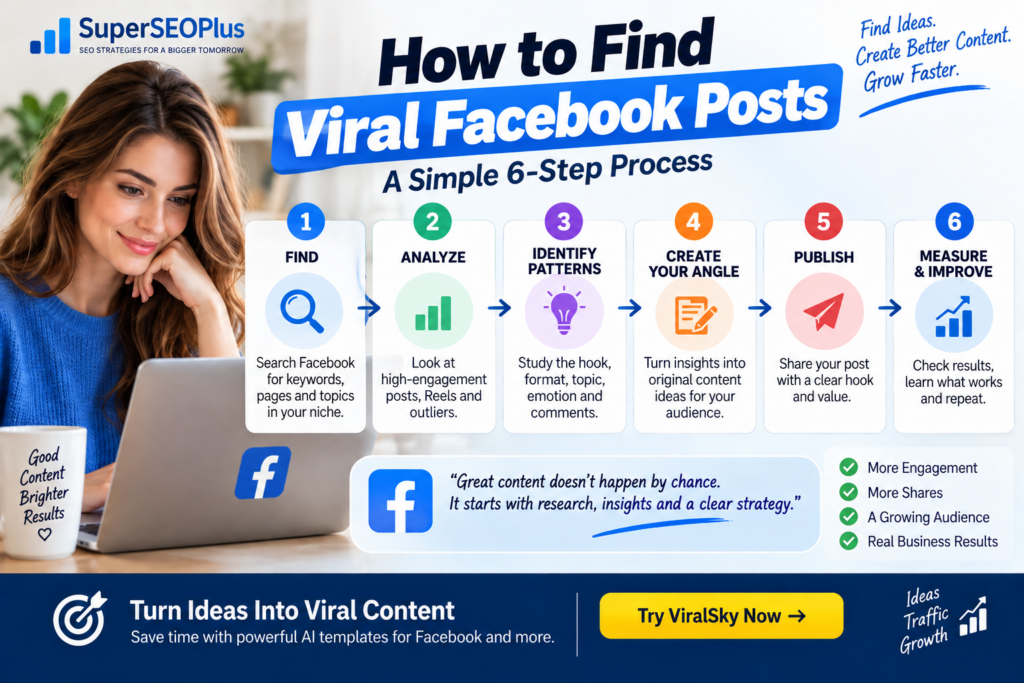
A six-step process for finding viral Facebook posts, analyzing successful content and turning the insights into original content ideas.
1. Study Successful Facebook Pages in Your Niche
Start with pages that consistently publish content related to your subject.
If you run a local SEO business, for example, look at pages discussing SEO, Google Business Profile, digital marketing, small-business growth and website development.
Don't simply open the latest post. Review a reasonable sample of recent content and look for posts that perform noticeably differently from the page's normal activity.
Ask:
- Which subjects generate the most discussion?
- Which formats appear repeatedly?
- What does the opening sentence look like?
- Is the post educational, entertaining, controversial or emotional?
- What questions are people asking in the comments?
The comparison matters more than the raw numbers. A post with 500 interactions on a small niche page may be more interesting for research than a celebrity post with 50,000 interactions.
2. Look for Outlier Posts
An outlier is a post that performs substantially better than the creator's typical content.
Suppose a page normally receives modest engagement but one particular post attracts an unusually large number of comments and shares. That post deserves investigation.
Look at what changed:
- Was the subject different?
- Was there a stronger opening?
- Did the creator use video instead of an image?
- Was the post shorter?
- Was there a useful list or tutorial?
- Did it address a timely question?
Outlier research is one of the most useful ways to find potential Facebook post ideas because you are studying exceptions rather than simply looking at popular accounts.
3. Research Facebook Reels
If video is part of your strategy, Facebook Reels can provide a large source of content inspiration.
Pay particular attention to the first few moments of successful videos. Before analyzing editing effects or music, ask what made you continue watching.
It may have been:
- a direct question;
- a surprising statement;
- a visually interesting opening;
- a problem you immediately recognized;
- a demonstration;
- a promise to explain something useful.
Write down the structure, not the exact wording.
For example, instead of copying:
"Stop doing this if you want more customers."
record the underlying pattern:
Hook pattern: warn the audience about a common mistake connected to a desired outcome.
You can then apply that structure to a completely different subject.
4. Read the Comments, Not Just the Post
The comment section can be more valuable than the original post for generating ideas.
Look for comments such as:
- "How do I do this?"
- "Does this work for small businesses?"
- "What tool are you using?"
- "Can you explain the second step?"
- "What if I don't have a large following?"
Each recurring question can become another piece of content.
For example, if people repeatedly ask how to find content ideas without spending hours researching Facebook, that question could become:
- a Facebook post;
- a Reel;
- a tutorial;
- a comparison;
- a checklist;
- or a complete blog article.
This is an effective way to build Facebook content ideas around demonstrated audience questions rather than assumptions.
5. Search Topics, Questions and Problems
Don't limit your research to individual creators.
Search Facebook using subjects connected to your niche and explore public content around them.
Instead of searching only for broad phrases such as "SEO," try problem-oriented topics such as:
- why isn't my website ranking;
- how to get more local customers;
- Google Maps visibility;
- website traffic;
- content ideas;
- Facebook engagement;
- social media mistakes.
Problem-based research can reveal the language real audiences use when discussing their needs.
6. Build a Swipe File of Ideas and Patterns
A swipe file is simply an organized collection of useful examples and observations.
You might record:
- the topic;
- the opening hook;
- the content format;
- the angle;
- why you think it attracted attention;
- interesting audience questions;
- your own original idea inspired by the pattern.
The final field is particularly important.
Your swipe file should not become a library of posts waiting to be copied. It should become a research database that helps you generate better original ideas.
7. Analyze the Hook Separately From the Topic
A strong topic with a weak opening can still be ignored.
When studying viral Facebook posts, separate the subject from the presentation.
Imagine two posts discussing exactly the same issue.
One starts:
"Here are some Facebook marketing tips."
Another starts:
"I reviewed our best-performing Facebook posts and noticed the same mistake kept appearing in the weakest ones."
The subject may be similar, but the second creates an information gap that gives the reader a reason to continue.
Useful hook structures include:
- The mistake: "If you're doing X, check this first."
- The question: "Why do some Facebook posts spread while others disappear?"
- The observation: "I noticed the same pattern in several high-engagement posts."
- The list: "7 Facebook content ideas you can adapt this week."
- The comparison: "Two posts. Same topic. Completely different response."
- The tutorial: "Here's how to research Facebook content ideas in 15 minutes."
8. Study Multiple Platforms for Transferable Ideas
A good content idea does not necessarily originate on Facebook.
You can discover topics on:
- YouTube;
- TikTok;
- Instagram;
- LinkedIn;
- Reddit;
- industry forums;
- Google search results;
- newsletters;
- competitor blogs.
The important part is adapting the idea to Facebook rather than simply reposting the same material everywhere.
A long YouTube tutorial might become a concise Facebook checklist. A detailed blog article might become a short Reel. A frequently asked Reddit question might become a Facebook discussion post.
This gives you a much larger pool of potential ideas.
9. Use AI to Organize Research, Not Replace Original Thinking
AI can make content research faster, but it works best when you give it useful source material and clear instructions.
Instead of asking:
"Give me 20 viral Facebook posts."
try a process such as:
- collect several successful content examples;
- identify their topics and hook structures;
- list questions appearing in the comments;
- group recurring themes;
- generate new angles for your specific audience;
- rewrite and fact-check the final content yourself.
This approach keeps human judgment at the center of the process.
Want a faster way to develop content from proven formats?
If manually collecting and organizing viral-content patterns takes too much time, ViralSky offers viral-content templates and AI-assisted creation for social platforms including Facebook.
Explore ViralSky and see how it works →
Affiliate disclosure: I may receive a commission if you purchase through this link, at no additional cost to you.
10. Turn One Winning Idea Into Multiple Original Posts
Finding a promising topic should not result in only one post.
Suppose your research suggests that small-business owners are highly interested in the question:
"Why is my Facebook content getting views but no engagement?"
You could develop that single subject into:
- Educational post: 5 reasons people view but don't interact;
- Reel: 3 engagement mistakes in 30 seconds;
- Checklist: what to check before publishing;
- Question post: "What's harder for you: getting views or getting comments?"
- Case analysis: compare two different post structures;
- Long-form guide: how to improve Facebook engagement.
This is far more efficient than searching for a completely new topic every day.
How to Analyze Viral Facebook Posts
Finding popular content is only the first half of the process. The next step is understanding why it attracted attention.
Use this simple framework when analyzing a post:
| Element | What to Examine |
|---|---|
| Topic | What problem, desire, question or interest does the post address? |
| Hook | What makes someone stop and continue reading or watching? |
| Format | Text, image, Reel, list, story, tutorial, question or another format? |
| Value | What does the audience gain from consuming the post? |
| Emotion | Does it create curiosity, surprise, recognition, excitement or another response? |
| Comments | What questions and reactions appear repeatedly? |
| Shareability | Why might someone want another person to see it? |
| CTA | Does the post naturally encourage discussion or another action? |
After analyzing several posts, look for repeated patterns rather than treating one successful post as proof of a universal formula.
How to Make Viral Facebook Posts Without Copying Competitors
This distinction is essential.
Research the pattern. Don't copy the content.
If another creator succeeds with a post called:
"7 SEO mistakes killing your local visibility"
you should not simply reproduce the article, wording or examples.
Instead, identify the underlying structure:
- specific audience problem;
- mistake-based hook;
- numbered format;
- clear consequence;
- actionable solutions.
You can apply that structure to an original subject:
"5 Google Business Profile mistakes that can make it harder for customers to find accurate information about your business."
The framework inspired the idea. The resulting content is original.
Facebook Post Ideas You Can Adapt to Almost Any Niche
If you're struggling with what to publish next, these structures can help you turn your expertise into useful content.
1. The Common Mistake Post
Identify a mistake your audience frequently makes and explain how to correct it.
2. The Before-and-After Post
Show how a process, design or approach changes after an improvement. Use genuine examples and avoid manufacturing results.
3. The Checklist
Give readers a short list they can use before completing a task.
4. The Myth vs. Reality Post
Address a misconception in your industry and explain the nuance behind it.
5. The Quick Tutorial
Teach one small task from beginning to end.
6. The FAQ Post
Turn a question customers repeatedly ask into useful public content.
7. The Comparison Post
Compare two legitimate approaches and explain when each might make sense.
8. The Behind-the-Scenes Post
Show part of your real process, workflow or preparation.
9. The Opinion Question
Ask a genuine question that people in your niche are likely to have different experiences with.
10. The Resource Post
Collect useful tools, templates, references or learning resources around one problem.
How to Go Viral on Facebook: What You Can Actually Control
No creator can guarantee that a particular Facebook post will go viral. What you can control is the quality of your research and execution.
Focus on:
- choosing subjects your audience genuinely cares about;
- making the opening immediately understandable;
- removing unnecessary introductions;
- using the right format for the idea;
- making content easy to consume on mobile;
- providing a clear reason to keep reading or watching;
- creating original value instead of copying popular posts;
- learning from audience comments;
- testing different hooks and formats;
- reviewing your own performance data over time.
The objective should not be to manufacture a viral hit every time. A more sustainable objective is to develop a repeatable process for discovering better ideas and producing better content.
A Simple 20-Minute Facebook Content Research Workflow
You can turn everything in this guide into a practical routine.
Minutes 1–5: Find
Review several relevant pages, creators, Reels or topics and identify unusually interesting or high-engagement posts.
Minutes 6–10: Analyze
Record the topic, hook, format, audience problem and interesting comments.
Minutes 11–15: Transform
Generate several original angles inspired by the underlying patterns.
Minutes 16–20: Choose
Select the idea that best matches your audience, expertise and current content goals.
Over time, this gives you your own database of proven subjects and content structures.
Short on Time? Turn Research Into Content Faster
If you understand the strategy but don't want to manually build every post from scratch, ViralSky is one option worth reviewing. Its platform focuses on viral-content templates and AI-assisted content creation across social platforms, including Facebook.
Use it as a starting point for ideas and structure, then apply your own expertise, facts, examples and brand voice before publishing.
Disclosure: This is an affiliate link. I may earn a commission from qualifying purchases at no additional cost to you.
Common Mistakes When Looking for Viral Content Ideas
Copying Instead of Researching
A successful competitor post is evidence that a subject or format may interest an audience. It is not permission to reproduce the creator's work.
Looking Only at Likes
Comments, shares, audience questions and performance relative to the creator's usual posts can provide more useful context.
Assuming One Viral Post Proves a Formula
One post can succeed for many reasons. Look for recurring patterns across multiple examples.
Choosing Ideas That Don't Match Your Audience
A format that performs well for an entertainment page may not suit an accounting firm, local contractor or B2B software company.
Using AI Without Editorial Judgment
AI can accelerate brainstorming and drafting, but facts, positioning, examples and final editorial decisions still require human review.
Trying to Force Keywords Into Facebook Posts
A social post should primarily be written for the people using the platform. Search optimization and social engagement are related disciplines, but they are not identical.
How to Build a Repeatable Facebook Content System
The strongest long-term approach is not hunting for one magical viral post. It is building a system.
- Research: find interesting topics and outliers.
- Analyze: understand the hook, format and audience response.
- Ideate: create several original angles.
- Create: develop the strongest idea for your audience.
- Publish: present it in a format suited to Facebook.
- Measure: review your own performance data.
- Learn: identify what worked and what didn't.
- Repeat: feed those insights back into your next content cycle.
This changes content creation from random inspiration into a repeatable process.
Frequently Asked Questions About Viral Facebook Posts
How do I find viral Facebook posts?
Start by studying public pages, creators and topics in your niche. Look for posts that perform unusually well relative to the account's typical content, then analyze their topic, hook, format and audience response. Comments can also reveal questions that lead to new content ideas.
How can I find Facebook content ideas?
Study audience questions, successful competitor topics, Facebook Reels, comments, search topics and content performing well on other platforms. Build a swipe file containing patterns and ideas rather than copied posts.
How do I make a Facebook post go viral?
There is no guaranteed method. You can improve your chances of producing engaging content by choosing relevant topics, writing stronger hooks, making posts easy to consume, providing original value and learning from your audience's response.
Should I copy viral Facebook posts?
No. Study why the content worked and use the underlying pattern to inspire an original post. Copying another creator's wording, creative work or distinctive expression is not a sustainable content strategy.
Can AI help create Facebook content?
Yes. AI can help organize research, brainstorm angles, adapt content structures and create drafts. The strongest workflow still involves human review for accuracy, originality, relevance and brand voice.
How often should I research viral content?
A short research session once or twice a week can be enough to maintain an idea pipeline. The appropriate frequency depends on how often you publish and how quickly your niche changes.
Are Facebook Reels better than text posts?
They serve different purposes. Reels can be effective for visual, demonstrative or fast-moving ideas, while text posts can work well for stories, explanations, questions and discussions. Test formats against your own audience rather than assuming one format will always perform better.
Final Thoughts
The best way to use viral Facebook posts is not to copy them. Use them as research.
Study what captures attention. Examine the questions people ask. Identify recurring subjects. Break successful posts into their underlying structures and then rebuild those ideas around your own knowledge, audience and perspective.
If you do this consistently, you no longer need to sit in front of an empty screen wondering what to publish.
You develop a system for finding Facebook post ideas, evaluating them and turning the strongest opportunities into original content.
And if the research-to-draft stage is consuming too much of your time, you can review ViralSky here to see whether its viral-content templates and AI-assisted workflow fit the way you create content.
Affiliate disclosure: The ViralSky link on this page is an affiliate link. If you purchase through it, I may receive a commission at no additional cost to you. No particular level of views, engagement, followers or revenue is guaranteed.
About us and this blog
We are a digital marketing company with a focus on helping our customers achieve great results across several key areas.
Request a free quote
We offer professional SEO services that help websites increase their organic search score drastically in order to compete for the highest rankings even when it comes to highly competitive keywords.
More from our blog
See all posts







Recent Posts
- AI Affiliate Program Guide: 15 Programs Compared (2026) September 28, 2026
- How to Use ChatGPT for Studying: A Practical Guide With 25 Prompts September 27, 2026
- Affordable WordPress Website Design That Gets Your Business Online September 27, 2026