Is Search Engine Submission Necessary in 2026? Complete Guide
- August 26, 2026
- SEO Guides
Is search engine submission still necessary in 2026? Not in the way it once was. You do not need to pay a company to “submit your website to hundreds of search engines,” and modern search engines can discover websites naturally through links and other crawling signals.
However, website owners should still understand how search engine discovery and indexing work. Google Search Console, XML sitemaps, internal links and tools such as IndexNow can all help search engines discover new or updated content efficiently.
In this guide, we explain what search engine submission means today, whether you need it, and the practical steps you can take to help Google and other search engines discover your website.
What Is Search Engine Submission?
Search engine submission traditionally meant manually sending a website URL to search engines and asking them to add the site to their index.
Years ago, website owners often submitted their websites individually to multiple search engines. Some SEO companies even sold search engine submission packages promising submission to dozens or hundreds of search engines.
Modern search engines work differently. Their automated crawlers continuously discover pages by following links and processing information about websites across the web.
As a result, manually submitting every page to every search engine is generally unnecessary.
Do You Need to Submit Your Website to Google?
No, submitting a website manually is not a requirement for appearing in Google Search.
Google can discover pages through crawlable links from pages it already knows about. A properly structured website with good internal linking therefore gives search engines clear paths for discovering additional pages.
An XML sitemap can also help Google discover URLs on your website, particularly when a website is new, has many pages, or has recently undergone significant changes.
However, discovery does not guarantee indexing. Google ultimately decides which pages it crawls, indexes and displays in its search results.
How Google Discovers New Web Pages
Google can discover URLs in several ways. For most business websites, the following are particularly important:
- Internal links: Links between pages help users and search engine crawlers navigate your website.
- External links: Links from other websites can help search engines discover your pages while also providing other potential SEO and referral benefits.
- XML sitemaps: A sitemap provides search engines with a structured list of URLs you want them to know about.
- Google Search Console: Website owners can inspect individual URLs and request indexing when appropriate.
This is why building a technically accessible website is much more important than repeatedly submitting URLs to search engines.
What Is an XML Sitemap?
An XML sitemap is a file containing information about important URLs on your website. It helps search engines understand which pages you would like them to discover and crawl.
For WordPress websites, sitemaps can often be generated automatically by WordPress itself or through an SEO plugin.
A sitemap is particularly useful for:
- new websites with relatively few external links;
- large websites containing many URLs;
- websites with pages that are not extensively linked internally;
- sites publishing or updating content frequently;
- websites that have recently been redesigned or migrated.
It is important to understand that submitting a sitemap does not guarantee indexing or higher rankings. It primarily helps search engines discover and understand your URLs.
How to Submit a Sitemap to Google
One of the most useful ways to communicate your website structure to Google is through Google Search Console.
- Verify your website in Google Search Console.
- Locate your XML sitemap URL.
- Open the Sitemaps section in Search Console.
- Enter your sitemap URL.
- Submit it and monitor its processing status.
Once submitted, Search Console can provide information about whether Google successfully processed the sitemap and can help you investigate indexing issues.
How to Request Indexing for an Individual URL
If you have published an important new page or substantially updated an existing one, Google Search Console provides a URL Inspection tool.
- Open Google Search Console.
- Enter the complete page URL into the URL Inspection field.
- Review Google's information about the URL.
- If appropriate, select Request Indexing.
This can be useful after publishing or significantly updating an important page, but repeatedly requesting indexing for the same URL will not make Google crawl it faster.
Google also makes clear that requesting indexing does not guarantee that a page will appear in its search results.
Should You Submit Every New Blog Post Manually?
Usually, no.
A healthy website should make new content discoverable through its architecture. For example, a new blog article might automatically appear on the blog archive, category pages, related-post sections and internal links from other relevant articles.
Your XML sitemap should also be kept up to date.
Manual indexing requests are better treated as an additional tool for selected URLs rather than as a substitute for good website architecture.
What About Bing?
Bing also provides webmaster tools for website owners. In addition, Bing strongly recommends IndexNow, a protocol designed to notify participating search engines when URLs are added, updated or deleted.
Instead of waiting for a crawler to discover that something has changed, IndexNow allows a website to proactively notify supported search engines about the changed URL.
For WordPress websites, IndexNow support may be available through compatible plugins or other website infrastructure.
Does Search Engine Submission Improve Rankings?
No. Submission itself is not a ranking strategy.
Getting a search engine to discover a URL and getting that URL to rank competitively are different challenges.
For sustainable organic visibility, businesses should focus on factors such as:
- creating genuinely useful content that satisfies search intent;
- maintaining a crawlable and technically sound website;
- using clear website architecture and internal linking;
- optimizing titles, headings and page content appropriately;
- improving website performance and user experience;
- earning relevant mentions and links;
- keeping important content accurate and up to date.
Why Isn't My Website Appearing in Google?
If your website or a specific page is not appearing in Google, repeatedly submitting the URL may not solve the underlying problem.
Possible issues include:
- the website or page is very new;
- Google has not discovered the URL yet;
- the page is blocked from crawling;
- a
noindexdirective prevents indexing; - Google considers another URL to be the canonical version;
- the page has limited original or useful content;
- the website has weak internal linking;
- technical problems prevent search engines from accessing or rendering the page correctly.
Google Search Console should therefore be one of the first places you investigate when diagnosing indexing problems.
Do You Need to Pay for Search Engine Submission?
No. You do not need to pay a third-party company simply to submit your website to Google.
Be cautious with services promising guaranteed Google indexing or submission to hundreds or thousands of search engines.
No legitimate SEO provider can guarantee that Google will index or rank a particular page simply because it was submitted.
Professional SEO services can be valuable for technical audits, content strategy, keyword research, local SEO, website architecture, link acquisition and other areas—but basic URL submission should not be confused with an SEO strategy.
Search Engine Submission Checklist for 2026
Instead of repeatedly submitting your website to search engines, use this practical checklist:
- Set up and verify Google Search Console.
- Make sure important pages are crawlable and indexable.
- Create or verify your XML sitemap.
- Submit the sitemap through Google Search Console.
- Use clear internal links between relevant pages.
- Inspect important URLs when troubleshooting indexing.
- Request indexing selectively after important additions or updates.
- Consider Bing Webmaster Tools and IndexNow.
- Publish useful, original content that matches real search intent.
- Monitor indexing and organic search performance over time.
Frequently Asked Questions
Is search engine submission necessary?
No. Modern search engines can discover websites and pages automatically. However, XML sitemaps, internal linking and webmaster tools can make discovery and monitoring easier.
Do I need to submit my website to Google?
No. Google can discover your website without manual submission. Nevertheless, setting up Google Search Console and submitting your sitemap are sensible steps for most website owners.
How do I submit a new URL to Google?
If you manage the website, you can inspect an individual URL in Google Search Console and use the Request Indexing option when appropriate.
Does requesting indexing guarantee Google rankings?
No. Requesting indexing does not guarantee indexing, and indexing itself does not guarantee rankings. Ranking depends on Google's systems evaluating the page in relation to relevant searches and competing content.
Should I submit my sitemap every time I publish a post?
Normally, no. A properly configured sitemap should update as your website changes. Search engines can revisit it to discover new or updated URLs.
Is IndexNow useful for SEO?
IndexNow can help participating search engines learn more quickly when URLs are created, updated or deleted. It is a discovery mechanism rather than a guarantee of indexing or higher rankings.
Final Thoughts: Focus on Indexability, Not Submission
The old concept of repeatedly submitting a website to numerous search engines has largely been replaced by automated crawling, XML sitemaps, webmaster platforms and modern URL notification technologies.
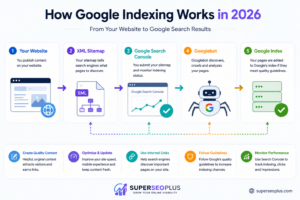
How search engine submission works in 2026, from XML sitemaps and Google Search Console to crawling and indexing.
For most businesses, the objective should not simply be to “submit” a website. The real objective is to build a website that search engines can efficiently discover, crawl and understand—and that provides enough value to compete for relevant searches.
If your website is struggling with indexing, rankings or organic traffic, the underlying issue may require more than URL submission.
SuperSEOPlus can help you identify technical SEO problems, improve search visibility and develop an SEO strategy focused on sustainable organic growth.
About us and this blog
We are a digital marketing company with a focus on helping our customers achieve great results across several key areas.
Request a free quote
We offer professional SEO services that help websites increase their organic search score drastically in order to compete for the highest rankings even when it comes to highly competitive keywords.
More from our blog
See all posts






Recent Posts
- Service-Area Business on Google Maps: How to Set It Up Properly October 20, 2026
- SEO Backlinks Explained: How They Work and How to Earn Them October 19, 2026
- On-Page SEO Checklist: 13 Checks for Every Page October 18, 2026